Whether you are planning a sports facility, lining a school field, setting up a youth tournament, or simply trying to understand the game better, football field specifications start with one practical question: which version of football are you measuring? American tackle football, flag football, and soccer all use rectangular fields, but their layouts, markings, and safety needs are very different. This guide breaks down football field dimensions, flag football field dimensions, and soccer field measurements in a clear, usable way.
What are the standard football field dimensions?
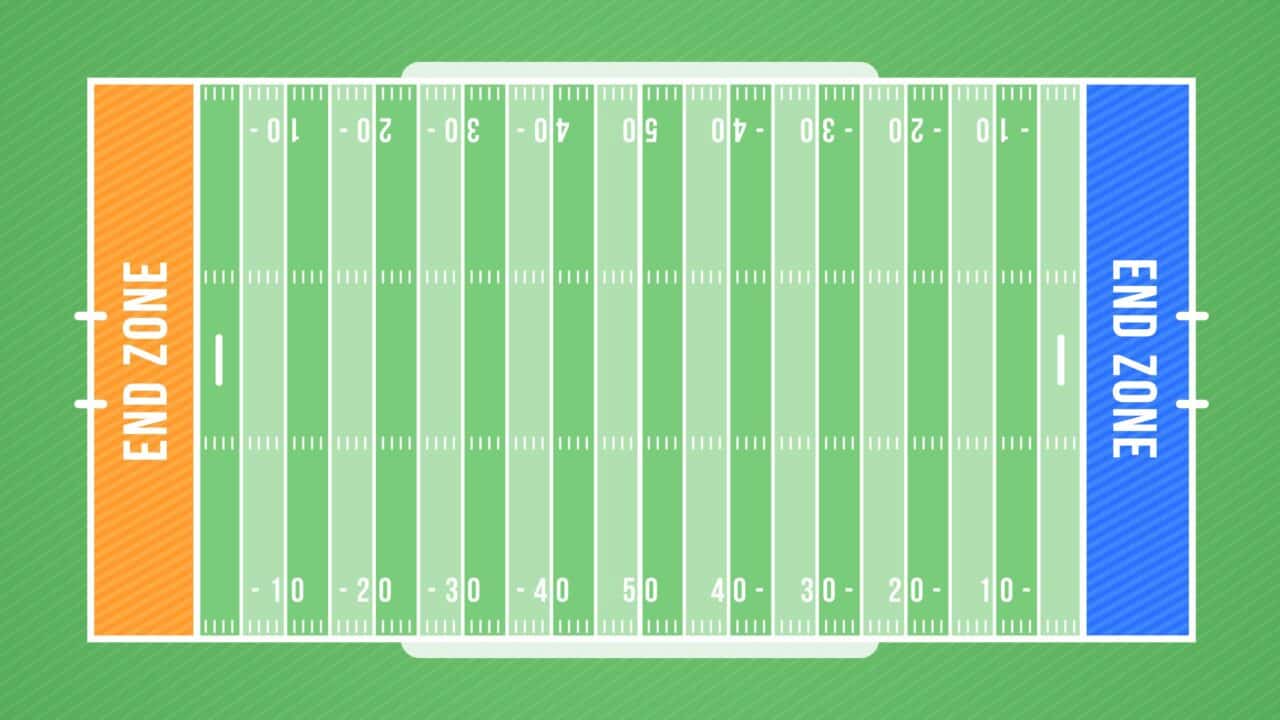
A standard American football field is 120 yards long from end line to end line and 53 1/3 yards wide, with a field of play that covers 100 yards and two end zones of 10 yards each. In feet, that makes the full football field size 360 feet long by 160 feet wide. These football field specs create the familiar gridiron layout used for tackle football, where yard lines, hash marks, goal lines, sidelines, and end lines all help officials spot the ball and manage play. The NFL notes that each end zone measures 10 yards by 53 1/3 yards, with end lines located 10 yards beyond the goal lines.
For planning purposes, the most important takeaway is that the playing area is not just the grass or turf between the goal lines. The full footprint includes the end zones, and a safe venue should also allow runoff space beyond the boundaries for players, officials, equipment, and spectators. If you are designing or marking a multiuse field, always confirm the governing body requirements before painting permanent lines.
Core markings on a football field
The gridiron looks simple from the stands, but each marking has a job. Goal lines mark where the field of play ends and the end zone begins. Sidelines define the long outer boundaries, while end lines close the field at the back of each end zone. Yard lines divide the field into measured segments so teams, officials, and spectators can track distance to the goal line and distance needed for a first down.
Hash marks are especially important because they determine where the ball is placed after many plays. In the NFL, hash marks run in intervals of one yard and are located 70 feet 9 inches from each sideline. Goalposts are placed behind the end line in the NFL, with a crossbar 10 feet above the ground and uprights 18 feet 6 inches apart.
A basic American football field marking checklist includes:
- Sidelines and end lines: The outside boundaries of the full field.
- Goal lines: The front edge of each end zone and the line a ball must cross for a touchdown.
- End zones: Two scoring areas, each 10 yards deep.
- Yard lines: Full width lines typically marked every five yards, with numbered markers to aid orientation.
- Hash marks: Short interior marks used to spot the ball.
- Goalposts: Uprights used for field goals and extra points.
- Team areas and safety zones: Spaces off the field that keep players, coaches, officials, and spectators organized.
These details matter because accurate football field dimensions support fair play. A field that is too narrow, poorly marked, or missing safe buffer areas can create confusion and increase operational problems, especially during competitive events. Fans following the sport at the college level can dig deeper into the game itself in RallyFuel’s complete guide to college football NIL, or browse RallyFuel’s football athlete directory to start fueling players directly.
How do flag football field dimensions compare?
Flag football field dimensions are typically smaller than tackle football dimensions because the game uses fewer players, less contact, and a faster open field style. NFL FLAG’s own rules describe a field of play 50 yards long, plus two end zones of 10 yards each, for a total length of 70 yards, with a width of 25 yards, although fields can vary based on location and available space.
That smaller footprint is one reason flag football works well for schools, parks, and tournaments with limited space. A full size soccer or football venue can often be divided into multiple flag fields, making it easier to run several games at once. The dimensions of flag football field layouts may change by age group, league, and event format, so coaches and facility managers should treat the official league rulebook as the final authority. For a closer look at how possession, scoring, and no run zones actually play out on the field, see RallyFuel’s breakdown of NCAA women’s flag football rules, and browse RallyFuel’s flag football athlete directory if you want to fuel the players competing on these fields.
A practical flag football setup usually includes:
- A central playing area: Often around 50 yards before end zones in NFL FLAG style formats.
- Two end zones: Commonly 10 yards deep.
- A moderate width: Often around 25 yards, creating enough space for passing routes without overwhelming young players.
- Midfield or line to gain markings: Used to structure possession and first downs.
- No run zones: Areas near scoring zones where rules may require a pass instead of a running play.
- Cones or pylons: Useful for temporary fields, especially on shared grass or turf.
The key is to match the field to the format. Younger players generally benefit from smaller spaces that encourage involvement, while older or more competitive groups may need more room for route combinations, defensive spacing, and speed. The format is also growing fast at the college level, covered in RallyFuel’s look at how 7v7 flag football is reshaping recruiting.
Soccer field measurements follow a different standard
Soccer field measurements are more flexible than American football dimensions. Under IFAB’s Laws of the Game, the touchline must be longer than the goal line, with a standard field of play ranging from 90 to 120 meters long and 45 to 90 meters wide. For international matches, the range tightens to 100 to 110 meters long and 64 to 75 meters wide.
This is why soccer pitch size can vary from one venue to another while still being legal. A compact pitch may create a faster, more crowded game, while a larger pitch can reward endurance, width, switching play, and longer passing patterns. When people compare soccer field measurements with football field specs, they sometimes expect one universal soccer number, but the laws allow a range within competition rules. Fans of the college game can find more on how that translates to support and sponsorship in RallyFuel’s guide to soccer NIL, or browse RallyFuel’s soccer athlete directory to start fueling players.
The main soccer field elements include:
- Touchlines: The long boundaries of the pitch.
- Goal lines: The shorter boundaries where the goals sit.
- Halfway line and center circle: Used for kickoffs and restarts.
- Penalty areas: Larger boxes that shape goalkeeper privileges, penalties, and defensive organization.
- Goal areas: Smaller boxes near each goal.
- Corner arcs: Quarter circles used for corner kicks.
- Goals: IFAB lists the distance between the inside of the posts as 7.32 meters, or 8 yards, with the crossbar 2.44 meters, or 8 feet, above the ground.
Football, flag football, and soccer at a glance
Although all three sports use rectangular fields, they are designed around different movement patterns. American football is built around set plays, measured yardage, controlled restarts, and a consistent grid. Flag football keeps some of that structure but compresses the field to support speed, passing, and safer non contact play. Soccer uses a larger continuous play surface where field width and length influence tactics, pressing, and stamina.
A quick planning comparison looks like this:
- American tackle football: Best understood as a fixed gridiron footprint of 120 yards by 53 1/3 yards, including end zones.
- Flag football: Usually smaller and more flexible, with many NFL FLAG style fields around 70 yards by 25 yards depending on format and available space.
- Soccer: More variable, with adult pitches falling within approved length and width ranges rather than one single universal size.
For facility planners, this means permanent markings should be chosen carefully. A school or park that hosts multiple sports may need layered lines, removable paint, cones, or differently colored markings to avoid confusion. The more sports a field supports, the more important it becomes to document the exact football field specs for each program before the season begins.
Practical field planning considerations
Accurate dimensions are only one part of a usable sports field. The surface, drainage, visibility, equipment placement, and safety buffer all affect the quality of play. A field can technically fit inside a property and still feel cramped if benches, spectators, fences, or neighboring fields are too close to the boundary.
Before finalizing a layout, walk the site and consider how the field will function on a busy game day. Players need room to slow down after crossing a sideline. Officials need clear sightlines. Coaches need organized team areas. Spectators need safe viewing locations that do not interfere with play.
Use this checklist before marking or approving a field:
- Confirm the sport and rule set. Do not assume tackle football, flag football, and soccer use interchangeable measurements.
- Measure the full footprint. Include end zones, runoff areas, team areas, and equipment zones.
- Check age and competition level. Youth, recreational, high school, collegiate, professional, and tournament formats may differ.
- Plan for line clarity. Shared fields should use distinct colors or temporary markings where possible.
- Inspect the surface. Look for holes, uneven seams, drainage issues, slick spots, or worn turf.
- Place equipment safely. Goals, pylons, cones, chains, benches, and portable signs should never create unnecessary hazards.
- Review before each event. Weather, maintenance, and heavy use can change field conditions quickly.
Choosing the right field size for your program
The best football field size is the one that fits the sport, the players, and the purpose of the event. A full tackle football field provides the structure needed for football played 11 to a side. A smaller flag football field encourages pace, participation, and efficient tournament scheduling. A soccer pitch should match the competition rules while giving players enough space for the style and level of play.
If you are working with limited space, start with the essentials that cannot be skipped: safe boundaries, correct scoring areas, and clear markings. From there, adjust the layout according to the league’s accepted range. Temporary fields can still feel professional when they are measured carefully, marked consistently, and supported by clear signage.
For multiuse facilities, the smartest approach is to create a field map for each sport. Include the dimensions, line colors, equipment needs, setup time, and inspection steps. That simple document reduces confusion for coaches, maintenance teams, officials, and event organizers.
Final takeaway
Football field specifications are not a single universal formula. American football dimensions are built around a fixed gridiron, flag football field dimensions are smaller and more adaptable, and soccer field measurements allow a wider approved range. When you understand those differences, it becomes much easier to plan a safe, organized, and enjoyable playing space for every game.
Use the official rule set for your league, measure carefully, and think beyond the boundary lines. A field that is planned well does more than meet the numbers; it helps the game flow, keeps participants oriented, and gives players room to compete with confidence.