
If you picture the sport as a silent, meditative lap in a community center, the atmosphere awaiting fans at the 2026 NCAA Championships will come as a shock to the system. Far from a polite gathering, these meets generate a literal wall of sound comparable to a basketball arena at the final buzzer, where the difference between a university dynasty and defeat is often measured in hundredths of a second.
For the household names you watched on the Olympic podiums, this season represents a notorious physiological hurdle known as the “post-Olympic reset.” Historical trends in collegiate swimming suggest that the year following the Summer Games often levels the playing field; while veteran stars battle the natural drop in motivation and physical peak known as the “hangover,” a vacuum opens for hungry underclassmen to seize the spotlight.
Unlike the expansive 50-meter lanes seen in international competition, the NCAA format is contested in a 25-yard “short course” pool. This compression transforms competitive swimming from a test of pure endurance into a high-velocity game of underwater harmonics and explosive turns, meaning the fastest swimmer in open water isn’t always the one who touches the wall first.
Summary
The 2026 NCAA Men’s Swimming & Diving Championships will be a high-octane, short-course showdown where walls, underwater speed, and roster depth matter as much as star power. A post-Olympic reset opens lanes for transfer-fueled blue bloods and a potent freshman class (Heilman, Williamson, Mijatovic), while seasoned champions aim to nail their taper and chase history like a sub-40 in the 100 free. Team titles hinge on flooding the top 16 and leveraging diving points and relays, not just winning individual races. For viewers, prioritize evening finals, track the record line and split times on streams, and expect a tight team race supercharged by a fast venue and marquee Friday–Saturday sessions.
The Secret Math of Team Titles: Why Winning a Race Isn’t Everything
While the TV cameras zoom in on the lone swimmer splashing to victory, the real battle is happening in the math. In the NCAA, a team comprised entirely of bronze medalists will often crush a squad relying on a single superstar. Championships aren’t decided by who touches the wall first in one race, but by which roster can flood the top 16 across three days of competition.
Every morning, hundreds of athletes race in preliminaries, but only the top 16 return at night to put numbers on the board. The fastest eight qualify for the “Championship Final” (A-Final), while the next eight fight for valuable leftovers in the “Consolation Final” (B-Final). Here is how the payoff works:
- A-Final (1st–8th): Major impact, netting 20 points for a win down to 11.
- B-Final (9th–16th): Critical depth, securing 9 points for winning the heat down to 1.
Because the drop-off from 16th (1 point) to 17th (zero points) is absolute, the most stressful moments often involve teammates just trying to make the cut. Winning the men’s swimming championships requires a lineup deep enough to score in every event, not just the sprints. Of course, getting that many swimmers to the wall first requires mastering a skill set that doesn’t exist in the Olympics: the art of the 25-yard turn.
Mastering the Walls: How 25-Yard Racing Differs from the Olympics
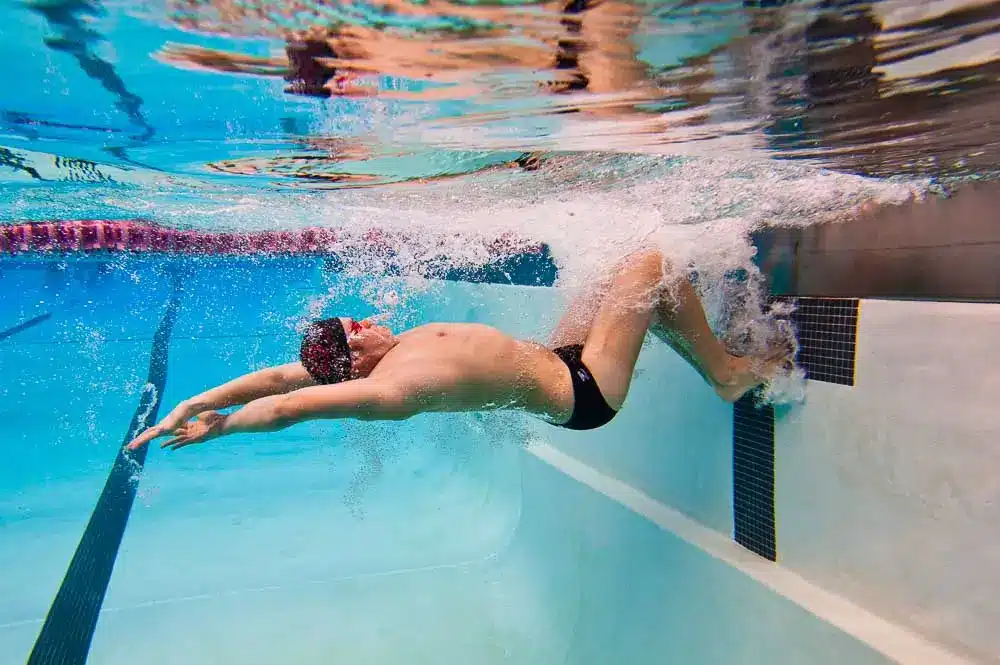
If you are used to the rhythm of Olympic broadcasts, the NCAA Championships will feel like watching a movie on fast-forward. While the Summer Games are contested in a 50-meter pool, collegiate competitive swimming takes place in a 25-yard tank, a format known as “Short Course Yards.” This seemingly minor dimensional change completely alters the physics of the sport. In the Olympics, pure endurance and stroke technique reign supreme because there is so much open water between ends. In the NCAA, the pool is effectively cut in half, meaning athletes spend significantly more time underwater, holding their breath to generate speed.
Because there are twice as many turns, the true weapon in collegiate racing isn’t the crawl or the butterfly, but the “fifth stroke”—the underwater dolphin kick. When a swimmer hits the wall, they push off in a streamlined torpedo position, kicking furiously before resurfacing. Preparation for short course yards versus long course meters is distinct because college athletes must master this explosive transition to survive. A swimmer might actually be slower on the surface but can win a national title simply by being a ballistic missile off the walls, generating velocity that surface swimming cannot match.
Consequently, the names atop the Olympic podium don’t always dominate the NCAA swimming competition. The format favors explosive powerhouses over rhythmic distance swimmers, creating upset opportunities that rarely happen in international waters. Watching the best underwater specialists hunt down superior surface swimmers in the final lap is the unique thrill of the 25-yard showdown. However, finding athletes who possess this specific, explosive skill set is difficult, leading top coaches to look beyond traditional recruiting to fill the gaps in their rosters.
The Transfer Portal Arms Race: Which Blue Bloods Rebuilt for 2026?
Modern collegiate swimming has adopted a philosophy closer to professional free agency than the traditional four-year development cycle. The impact of the collegiate transfer portal on championship rosters is undeniable; instead of waiting years for a teenager to mature, coaches now acquire seasoned veterans who can score points immediately. This “win-now” urgency forces programs to aggressively scout the portal for athletes who have already proven they can handle the pressure of a national meet, effectively allowing a team to rebuild its entire relay lineup in a single summer.
Nowhere is this arms race more volatile than in the battle for dominance between the heavyweights of the SEC and the Big Ten. These “Blue Blood” programs—think of them as the dynasties equivalent to Alabama Football or Duke Basketball—leverage their massive resources to stockpile talent that smaller schools simply cannot retain. While a mid-major school might cherish one superstar, a comparison of SEC and Big Ten swimming depth reveals that top-tier squads often field three or four potential champions in the same event. This redundancy is crucial because winning the NCAA team title requires accumulating points from fourth, fifth, and sixth-place finishes just as much as capturing gold medals.
The resulting projected collegiate swimming team rankings for 2026 heavily favor squads that have successfully blended this veteran transfer talent with their existing core. We are likely to see a podium dominated by older, battle-hardened rosters that treat the pool like a business trip rather than a field trip. However, even the most strategically assembled team of veterans faces a volatile variable that money and scouting can’t always predict: the raw, unmeasured potential of a record-breaking rookie class.
Freshman Firepower: How the Class of 2025 Will Crash the Podium
While the transfer portal allows teams to buy experience, the true chaos agents in any 2026 NCAA Championships preview are the rookies. In this sport, the “freshman bump” is a potent phenomenon; eighteen-year-olds often drop massive amounts of time once they trade local club training for the elite weight rooms and nutrition programs of a Division I university. These newcomers arrive without the scars of past defeats, ready to disrupt the carefully calculated points projections of veteran coaches.
The top collegiate swimming recruits class of 2025 will make their impact felt immediately through three standouts who are already faster than many college seniors:
- Thomas Heilman: A butterfly and freestyle specialist whose times already rival NCAA champions, making him an instant gold medal threat.
- Maximus Williamson: The ultimate “Swiss Army Knife” in the Individual Medley, capable of scoring massive points in diverse events.
- Luka Mijatovic: A distance freestyle prodigy expected to dominate the grueling 500 and 1650-yard races right out of the gate.
Identifying these breakout swimmers to watch next season relies on analyzing early fall results. If a freshman is challenging school records in November while physically exhausted from heavy training, they will likely be unstoppable when they rest and “taper” for March. Their raw speed forces the older superstars to elevate their own performance, setting the stage for a violent collision with the sport’s established kings.
The Titans of the Taper: Returning Champions to Watch in 2026
While rookies rely on raw adrenaline, the veterans understand the dark art of the “taper.” For months, swimmers break down their bodies with grueling yardage, only to drastically reduce their training volume weeks before the championship. This physiological slingshot effect allows muscles to fully repair and store energy, transforming tired athletes into aquatic rockets. The 2026 swimming title contenders are athletes who have mastered this timing; the returning individual national champions roster features masters of rest who know exactly how to peak during the final Saturday night session rather than a random Tuesday in February.
At the center of this year’s narrative is the chase for the most elusive barrier in the sport. Much like the four-minute mile once captivated track fans, breaking the 40-second barrier in the 100-yard freestyle remains the ultimate frontier. Top sprinters have flirted with the mark, but cracking historic 100-yard freestyle records requires a perfect confluence of reaction time, underwater power, and surface speed. Watching these titans fight the clock is tense; a hesitation on the starting block or a “long finish” into the wall is the difference between rewriting history and simply winning a gold medal.
Even the fastest swimmers can’t secure a team trophy alone. A program might dominate the swimming lanes yet watch their lead evaporate because they lack scoring power on the other side of the aquatic center. While the crowd focuses on the splash and speed of the lap pool, a quieter, gravity-defying battle takes place that often decides the final standings.
Finding Points Off the Boards: The Critical Role of NCAA Diving
Often treated as a halftime show by casual viewers, the diving well is actually the “special teams” unit of a championship roster. A team might sweep the swimming relays, but if they lack presence on the boards, they can bleed critical points to their rivals. The competition is split into three distinct disciplines: the 1-meter and 3-meter springboards, which emphasize height and rapid acrobatics, and the terrifying 10-meter platform, a static concrete tower nearly three stories high. In any 2026 NCAA Championships preview, experts closely monitor teams with “depth” here; a single elite diver making the finals in all three events can generate as many team points as a superstar sprinter, often deciding the national title while the swimmers are cooling down.
Judging might feel subjective compared to the absolute truth of a race clock, but the hallmark of a high-scoring dive is universally audible. Listen for the “rip entry”—a sharp sound like tearing heavy paper that signals a perfectly vertical entry with virtually no splash. This acoustic cue tells you the athlete disappeared underwater cleanly, satisfying the judges and maximizing their score. While NCAA diving qualifying scores and formats involve complex degrees of difficulty, the viewer’s rule of thumb is simple: the less water you see moving, the higher the score. These acrobatic points are added directly to the team total, making the diving well a decisive battlefield rather than a sideshow as we head toward the main events.
Your 2026 Championship Itinerary: Venue Details and Must-See Sessions
Unlike your local rec center, the facility hosting the 2026 NCAA Division I swimming championships is engineered for pure speed. These “fast water” pools feature deep bottoms to minimize turbulence and advanced gutter systems that swallow waves rather than bouncing them back at the swimmers. The water is even kept slightly cooler than a typical lap pool to prevent athletes from overheating during high-intensity exertion. This creates a specialized environment where hydrodynamics work in the swimmer’s favor and school records don’t just fall—they shatter.
The 2026 swimming championships meet schedule requires distinct strategies for “Prelims” and “Finals.” Every morning, hundreds of athletes fight just to make the top 16, but the true electric atmosphere arrives at night when the field is cut down to the best of the best. If you are looking to buy NCAA swimming championship tickets, prioritize the evening sessions to witness the trophy presentations and the loudest crowds.
To ensure you catch the peak action, mark your calendar for these nightly highlights:
- Wednesday: The 200 Medley Relay, a chaotic sprint that immediately sets the emotional tone.
- Thursday: The 50 Freestyle, the “splash and dash” crowning the fastest swimmer in the NCAA.
- Friday: The 100 Butterfly and Breaststroke, technical races where individual rivalries often boil over.
- Saturday: The 400 Freestyle Relay, the deafening finale that often mathematically decides the team title.
With your schedule set, the next challenge is learning how to decipher the broadcast graphics to spot a historic performance before the announcers even call it.
How to Watch Like a Pro: Live Streaming and Spotting a Record-Breaking Swim
While primary live streaming options for swimming and diving nationals usually land on ESPN platforms, the real magic happens in the on-screen overlays. You will often see a digital colored line moving across the water alongside the swimmers, similar to the yellow first-down marker in football. This “record line” represents the pace of the fastest swim in history. If the leader’s head stays ahead of that digital marker, you are watching a historic moment unfold live. This simple visual cue transforms a confusing mess of splashing water into a clear, high-stakes chase against history.
Beyond the record line, keep an eye on the “split times” flashing at the bottom of the screen every time a swimmer touches the wall. Every athlete here has already surpassed rigorous NCAA swimming time standards, so the difference on race day often comes down to these lap segments. A negative split—swimming the second half of the race faster than the first—is the gold standard for strategy and often signals a come-from-behind victory. These numbers reveal exactly which powerhouse teams are positioned to dominate the final standings.
The Road to the 2026 Title: What to Expect When the Water Settles
The Men’s Swimming & Diving 2026 NCAA Championships is not merely a race for gold, but a calculated war of attrition. While a superstar freshman might grab headlines with a record-breaking swim, the true title is decided by the quiet accumulation of depth points and the precise timing of “the taper.” Whether watching a powerhouse lean on its roster size or an underdog riding the momentum of a few elite stars, fans can track the real scoreboard long before the final relay blocks are loaded.
As the meet begins, focus your attention on the critical Friday night session where competitive swimming legends are often made and team titles solidified. Watch closely for how veterans handle the walls compared to rookies, as those underwater turns often separate champions from finalists. The fastest water in the world is unforgiving, but this environment creates the highest-stakes pressure cooker in collegiate sports. Pick a team, trust the clock, and enjoy the chaos.
Learn More About the NIL Landscape
Name, Image, and Likeness plays an increasing role in college sports, and understanding how it works often requires more than individual articles or news updates.
RallyFuel is a platform focused on NIL-related topics across college athletics. It brings together information about athletes, NIL activity, and the broader structure behind modern college sports, helping readers explore the topic in more depth.
Q&A
Question: What is the “post-Olympic reset,” and why does it matter for the 2026 NCAA Championships? Short answer: The year after the Olympics often levels the collegiate playing field as veteran stars experience a motivation and performance dip—the “hangover”—while underclassmen surge. In 2026, that reset creates openings for freshmen and transfers to steal points and headlines, tightening the team race and amplifying upsets.
Question: How does 25-yard short-course racing change who wins compared to the Olympics? Short answer: NCAA races in a 25-yard pool double the number of turns and underwater segments, making walls and the “fifth stroke” (underwater dolphin kick) decisive. Explosive starters and elite underwater specialists can out-touch stronger surface swimmers, so Olympic-caliber endurance doesn’t always translate to NCAA dominance.
Question: Why don’t a few event wins guarantee the team title? Short answer: Team championships are won by depth across the top 16, not just gold medals. After morning prelims, only 16 return: places 1–8 (A-final) score 20 down to 11 points, and places 9–16 (B-final) score 9 down to 1. The cliff from 16th (1 point) to 17th (zero) makes qualifying back at night crucial; rosters that flood both finals across three days typically beat teams leaning on one superstar.
Question: Who are the key newcomers and veterans to watch in 2026? Short answer: A powerhouse freshman trio—Thomas Heilman (butterfly/freestyle), Maximus Williamson (IM versatility), and Luka Mijatovic (distance free)—can score immediately, especially if they’re near school records in the fall before tapering. Veterans, including returning champions, will bank on precise taper timing, with sprint titans chasing the sport’s holy grail: a sub-40 in the 100-yard freestyle.
Question: What’s the smartest way to watch—and what about diving’s impact? Short answer: Prioritize evening finals for peak atmosphere and decisive points, with marquee nights Wednesday (200 medley relay), Thursday (50 free), Friday (100 fly/breast), and Saturday (400 free relay). On streams, use the record line and split times—negative splits often signal comebacks. Don’t overlook diving: elite finalists on 1m, 3m, and 10m can swing the team race; listen for the “rip entry” (minimal splash) as a cue for big scores.



Leave a Comment