
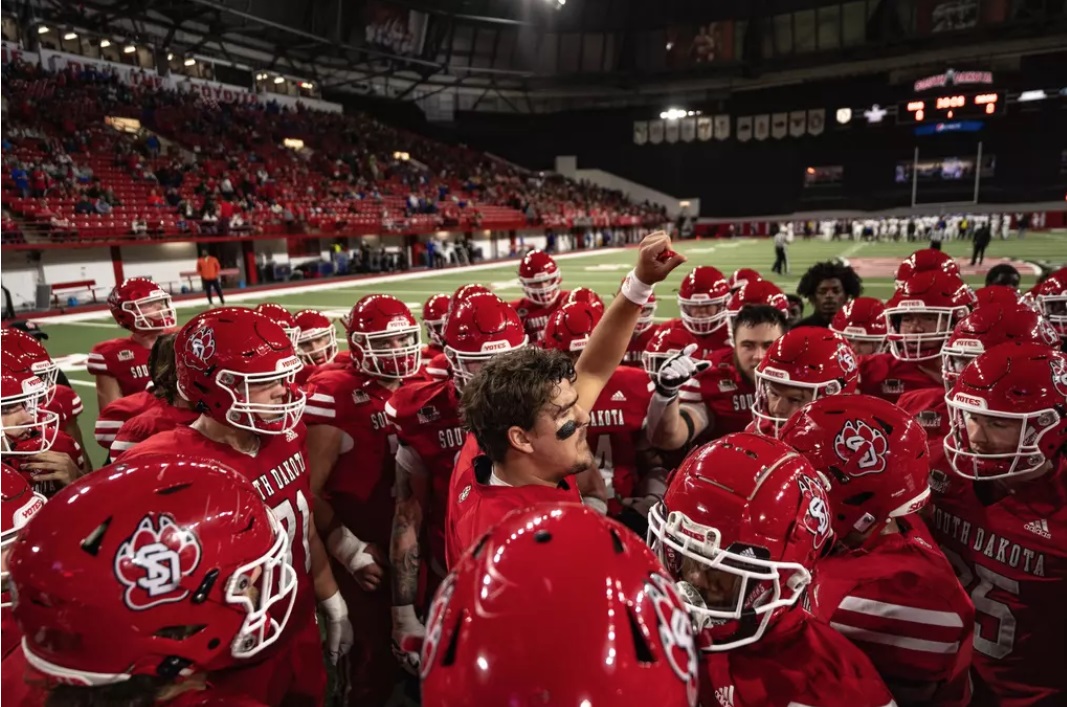
South Dakota operates WITHOUT a specific state NIL statute — a strategic hands-off approach. CEO Marty Jackley’s lawsuit against the NCAA saved the Summit League ~$2 million, forcing the NCAA to use a $55 million surplus. SDSU and USD agree to a House agreement on roster flexibility and competitive parity. “Jacked NIL” (SDSU) and “Pride of the Western Plain” (USD) teams move to internal integration. SDHSAA allows NIL at high schools (July 1, 2024, vote 115-7) with IP Wall. Missouri HB 417 = direct competitive threat due to pre-enrollment incentives. FCS Economic Reality: $20.5 million cap = ~100% of SDSU’s total athletic budget. Here’s the full guide.
The Evolution of NIL in South Dakota
South Dakota’s approach is defined by defensive flexibility—lawsuits with the Attorney General, the universities’ transition to collective governance, and a considered liberalization of the SDHSAA—rather than aggressive legislation.
Statute of the absence of state zero status — Strategic policy of state non-interference:
- South Dakota operates WITHOUT a specific NIL law (unlike over 30 states)
- Not an oversight — a strategic position
- After the NCAA’s interim policy (July 2021), state laws became restrictive obligations
- By not codifying restrictive parameters, sustainable development institutions retain flexibility
- Disadvantage: Lack of state-level “safe harbor” protection from NCAA law enforcement
CEO Marty Jackley’s lawsuit against the NCAA is a $2 million victory:
- NCAA proposed to resolve funding issue as per House decision by withholding conference funding allocation
- The formula disproportionately affected schools outside the Power 4 (Summit League, MVFC)
- SD filed a lawsuit: Power 4 caused the violation, Power 4 should not pay
- April 2025: The NCAA agreed to use a $55 million budget surplus to offset the cuts.
- Saved ~$2 million in redirected funds for Summit League and MVFC
- $2 million = 10-15% of total operating budget for smaller Summit League programs
- The NCAA also paid the SD Board of Regents $24,815 in legal costs
SDSU and USD agreed to a House settlement:
- Both SDSU (AD Justin Sell) and USD (AD Jon Schemmel) agreed
- Refusal to participate will lower the programs to a lower competitive level
- Lineup flexibility: Scholarship cap of 63 lifted; can offer up to 105 (football)
- Preservation: “grandfathering” clauses take into account current composition commitments
- Recruiting narrative: SDSU (FCS national champion) = “FBS-lite” perception
The $20.5 million cap is the economic reality of FCS:
- The agreement ALLOWS revenue sharing of $20.5 million; is not binding
- SDSU’s total athletic budget: ~$20-25 million
- $20.5 million limit = almost 100% of SDSU’s entire budget
- The limit is a desired ceiling; the real limit = donor capacity minus operating costs
- Section IX: If $1 million is allocated to soccer, it should provide proportional benefits to women’s sports.
- ‘Shadow Cost’ Effectively Doubles the Value of Every Dollar for Male Athletes
“Jacked NIL” team (SDSU):
- Launched by Jackrabbit Sports Properties
- Third-party organization integrated with the university’s intellectual property rights holder
- Focus: “Compliance with performance requirements” — centralized reporting, deal tracking
- Links NIL to national football dominance
- Transition to direct institutional support after settlement
Pride of the Western Plains (USD) Team:
- Partnership with the national agency Student Athlete NIL (SANIL)
- AD John Schemmel: Partnership ‘protects’ from ‘big’ actors
- Uses the Opendorse marketplace with a transparent pricing menu
- Example: $10 per mention, $100 per appearance
- A risk-avoidance strategy that prioritizes compliance over aggressive growth
SDHSAA NIL High School (July 1, 2024):
- Charter amendment allows monetization of NIL in high schools
- Voted 115-7 (an overwhelming majority of votes statewide)
- Coordinates with North Dakota, Minnesota, and Iowa — prevents “brain drain” to neighboring states
- Boundary fences preserve the educational environment
Why South Dakota matters:
South Dakota documents the economic reality of FCS — $20.5M cap is almost 100% of total budget. Attorney General Jackley’s lawsuit saved ~$2M (10-15% of smaller programs’ budgets). No state statute = flexibility, but no “safe harbor.” “Subscriber” model that shifts donors from philanthropy to monthly payments. Missouri HB 417 = direct competitive threat to talented schools. SDSU (FCS national champion) supports “FBS-lite” perception through consent.
NIL Rules at South Dakota College
Without a state charter, SD institutions operate under NCAA rules and House settlement terms, with teams focusing on internal integration.
What South Dakota offers:
- Revenue sharing allowed (limit of $20.5 million is the desired figure for FCS)
- Squad flexibility: up to 105 football scholarships (63-match cap lifted)
- Lack of restrictive state parameters to limit institutional facilitation
- Teams “Jacked NIL” (SDSU) and “Pride of the Western Plain” (USD)
- Teams move towards internal integration through university funds
Subscriber Model — Donor Evolution:
- Transition from “charitable” (tax write-off) to “prepaid” (monthly)
- Regular micro-donations (e.g. $20 per month) to maintain membership
- Treats fans as customers who buy a product (winning team)
- Fan forums are reporting fatigue with the model of paying for something that was “free.”
Change to “Direct Support”:
- After the settlement: universities move to direct institutional support
- SDSU: Consent allows department to directly “provide additional support”
- The beginning of the end of the “collectives as separate entities” model
- Expect absorption into the SDSU Foundation or USD Foundation
NIL rules in South Dakota high school
The SDHSAA bylaws amendment (July 1, 2024), passed by a supermajority of 115 to 7, allows for NIL (never considering the educational environment) with clear safeguards to preserve the educational environment.
Key facts:
- Governing Body: South Dakota High School Activities Association (SDHSAA)
- Status: Allowed with restrictions (effective July 1, 2024)
- Vote: 115-7 (statewide consensus on athlete monetization)
- Aligns with ND, MN, IA — prevents “talent drain”
SDHSAA protective fences:
No logos/uniforms: No use of school intellectual property (logos, uniforms, mascots) in NIL activities. Photo of high school player in jersey = PROHIBITED.
No Recruiting Incentive: NIL cannot encourage transfer to a specific high school or as an incentive for enrollment. Prohibited Categories: Alcohol, Tobacco, Vaping, Controlled Substances, Gambling, Firearms.
Institutional separation: Schools cannot facilitate agreements (“firewall” protects administrators).
Academic Priority: NIL activities should not interfere with academic responsibilities.
Missouri Competitive Threat (HB 417):
Missouri law HB 417 allows high school seniors to enter into no-in-law (NIL) agreements IF they are signed to a Missouri school. State-sanctioned recruiting incentive — designed to keep Missouri talent in Missouri. Elite quarterback from South Dakota can legally be recruited by Mizzou with an immediate no-in-law (NIL) upon signing. SDSU/USD cannot legally match under current South Dakota rules. Creates “regulatory arbitrage” for out-of-state recruits who lure talent from South Dakota.
College vs. High School: Key Differences
| Feature | College (House Settlement) | High School (SDHSAA) |
|---|---|---|
| NIL Status | Legal (no state statute) | Permitted (July 2024) |
| State Statute | NONE (strategic flexibility) | SDHSAA Bylaws |
| Institutional Pay | Permitted ($20.5M cap) | Prohibited |
| Collective Model | Pivoting to in-house | N/A |
| School Logos/Uniforms | Allowed | Prohibited |
| School Facilitation | Permitted | Prohibited ("firewall") |
| Pre-Enrollment Deals | N/A | Prohibited |
| Vice Industries | Prohibited (NCAA) | Prohibited |
Key Difference: South Dakota has NO state NIL statute — strategic flexibility, but no “safe harbor.” Attorney General Jackley’s lawsuit saved Summit League/MVFC ~$2 million. $20.5 million cap = almost 100% of SDSU’s total budget (ambitious, unattainable). “Subscriber” model that converts donors to monthly payments. Missouri HB 417 = direct competitive threat to gifted schools. SDHSAA allows NIL in higher education (115-7) with strict intellectual property restrictions and no incentives.
What South Dakota athletes can do
College athletes:
- Receive revenue sharing from the institution (subject to budget constraints)
- Work with “Jacked NIL” (SDSU) or “Pride of the Western Plain” (USD)
- Sign advertising deals with brands
- Monetize social media accounts
- Earn money from camps, clinics, and performances
- Sell autographs and merch
- Hire agents and lawyers for NIL contracts
- Get fan support through platforms like RallyFuel.
High school athletes:
- Sign commercial advertising agreements (without school affiliation)
- Monetize social media accounts (without school branding)
- Earn money from autograph sessions and performances
- Create a personal brand regardless of the school’s identity.
What South Dakota athletes can’t do
College athletes:
- Not recommended: gambling, alcohol, tobacco, adult entertainment, controlled substances (NCAA rules)
- Foreign students (F-1 visa): cannot engage in active non-indigenous activity (NIL) in the United States
- no state “safe harbor” provided—subject to NCAA enforcement for violations not related to settlement.
High school athletes:
- No school logos, uniforms, or mascots may be used.
- You can’t wear a school t-shirt in advertising.
- NIL cannot be accepted as an incentive for enrollment/transfer
- NIL should not be allowed to interfere with academic duties
- cannot recommend: alcohol, tobacco, vaping, other psychoactive substances, gambling, firearms.
Both:
Must pay NIL income taxes (SD has NO state income tax – competitive advantage); Must maintain academic eligibility.
Compliance requirements
For college athletes:
- Work with “Jacked NIL” (SDSU) or “Pride of the Western Plain” (USD)
- Report transactions >$600 to the “NIL Go” clearinghouse (House of Representatives settlement requirement)
- Disclose conflicts with institutional sponsors
- Avoid prohibited categories according to NCAA rules
- File only federal taxes (no SD state income tax).
For high school athletes:
- NEVER use school logos, uniforms, or mascots
- NEVER accept the absence of a NIL certificate as an incentive for enrollment/transfer
- NEVER let the lack of a NIL certificate interfere with your studies
- avoid prohibited categories
- The school cannot facilitate—families must manage the process themselves.
For parents:
For college:
- no state statute = flexibility, but no “safe harbor”
- FCS reality: $20.5 million cap is ambitious but unattainable
- transition of teams to an internal system (SDSU Foundation, USD Foundation)
- “subscriber” model = monthly donations to maintain the school list
- no SD state income tax = competitive advantage.
For high school:
- SDHSAA allows NIL (July 2024)
- strict protection of intellectual property = no school branding
- schools cannot help — families must navigate on their own
- Missouri bill HB 417 = threat of out-of-state stay due to pre-enrollment incentives.
How fans support South Dakota athletes
South Dakota has ardent Jackrabbit and Coyote fans, and now they can directly support the athletes through NIL.
College athletes:
Platforms like RallyFuel allow South Dakota fans to support athletes at:
- South Dakota State University (SDSU) – Summit League / MVFC (FCS)
- University of South Dakota (USD) – Summit League / MVFC (FCS)
- All sports – football, basketball and others
South Dakota Teams:
“Jacked NIL” (SDSU): Launched Jackrabbit Sports Properties. Emphasis on “compliance efficiency” — reporting, tracking, brand partnerships. Ties NIL to SDSU’s national dominance in football (FCS champion). “Pride of the Western Plain” (USD): Partnership with student-athlete NIL (SANIL). Uses Opendorse marketplace with transparent pricing. Risk-avoidance strategy that prioritizes compliance.
How it works:
1. Create an account on RallyFuel.com or the mobile app
2. Select your school in South Dakota
3. View verified athletes currently in your program
4. Support the athletes you want to support
5. Track your support through the fan dashboard
How it works: When you purchase Fan Fuel, you are purchasing Conditional No-Entry Entitlements (CNER). If the conditions are met, RallyFuel or its affiliate offers the athlete a NIL deal. If the conditions are not met, for example if the athlete moves to another team, you receive an automatic refund.
Contingency Protection: RallyFuel’s contingent model protects Fan Fuel with automatic refunds if athletes move to other countries or conditions are not met. South Dakota fans can support players without financial risk.
Important: Support for fans through RallyFuel is voluntary and conditional. Fuel purchases are not charitable donations. RallyFuel does not guarantee that any athlete will accept the No Donation Agreement. Fuel purchases for fans do not guarantee athletic performance, playing time, or any specific outcome.
High school athletes:
South Dakota high school athletes may utilize NIL opportunities under SDHSAA regulations (effective July 1, 2024) provided they completely separate themselves from their school identity and do not accept enrollment/transfer incentives.
Learn More About the NIL Landscape for Schools
Name, Image, and Likeness plays an increasing role in college sports, and understanding how it works often requires more than individual articles or news updates.
RallyFuel is a platform focused on NIL-related topics across college athletics. It brings together information about athletes, NIL activity, school responsibilities, and the broader structure behind modern college sports — helping readers explore the topic in more depth.
👉 Discover NIL Tools for Schools – Learn how your program can stay ahead of the NIL curve.
Frequently asked questions
Can South Dakota high school athletes pass the NIL?
Yes. The SDHSAA bylaws changes took effect July 1, 2024 (voted 115-7). Restrictions: No school logos, uniforms, or mascots may be used; No Dutch National Education (NIL) may be accepted as an incentive for enrollment/transfer; No Dutch National Education (NIL) may be allowed to interfere with instruction; Schools may not facilitate (“firewall”); Prohibited: Alcohol, tobacco, vaping, other substances, gambling, firearms.
Why doesn’t South Dakota have a statewide NIL law?
Strategic choice, not oversight. After the NCAA interim policy (July 2021), state laws became restrictive liabilities, not assets. By not codifying parameters, SD institutions retain flexibility to adapt to NCAA recommendations without legislative change. Disadvantages: No state “safe harbor” protection from NCAA enforcement.
What did Attorney General Jackley’s lawsuit achieve?
NCAA proposed to fund House settlement by withholding conference funding, which disproportionately affected non-Power 4 schools. SD argued: Power 4 caused the breach, so non-Power 4 schools should not pay. April 2025: NCAA agrees to use $55 million budget surplus to offset cuts. Summit League and MVFC saved ~$2 million. That $2 million = 10-15% of smaller programs’ operating budgets. NCAA also paid SD Board of Regents $24,815 in legal fees.
Can SDSU/USD realistically fund a $20.5 million revenue share?
No. SDSU’s total athletic budget is ~$20-$25 million. $20.5 million cap = almost 100% of total budget. The agreement ALLOWS but DOES NOT GUARANTEE spending within the cap. Real cap = donor capacity minus operating costs. Title IX “shadow spending” effectively doubles the value of every dollar spent on male athletes. SD schools will likely focus revenue allocation on high-achieving football/basketball.
Why is Missouri a competitive threat?
Missouri law HB 417 allows high school seniors to enter into no-in-line (NIL) agreements IF they sign with a Missouri school. This is a state-sanctioned recruiting incentive designed to keep Missouri talent in Missouri. An elite South Dakota quarterback can legally be recruited by Mizzou with an immediate NIL upon signing, a tool that SDSU/USD cannot match under current South Dakota rules. Creates “regulatory arbitrage” for out-of-state recruits who lure talent from South Dakota.
Does South Dakota have a state income tax on NIL?
NO. South Dakota has NO state income tax—a competitive advantage over most states. Athletes only pay federal and self-employment taxes. This makes South Dakota attractive to those who don’t have income taxes compared to high-tax states.
What happens if an athlete I supported transfers?
If an athlete transfers or chooses another school during the conditional period, you will receive an automatic refund to your original payment method. No manual request is required.
South Dakota: Defensive Agility in the FCS Landscape
South Dakota operates WITHOUT a state NIL statute — strategic flexibility, but no “safe harbor.” Attorney General Jackley’s lawsuit saved Summit League/MVFC ~$2 million, forcing NCAA to use $55 million surplus. SDSU and USD decided to make a deal with the House for roster flexibility and competitive parity. FCS economic reality: $20.5 million cap = almost 100% of SDSU’s total budget (desired cap). “Reduced NIL” and “Pride of the West Plains” move to internal integration. “Subscriber” model moves donors to monthly payments. SDHSAA allows NIL in HS (July 2024, 115-7) with strict restrictions. Missouri HB 417 = direct competitive threat due to early enrollment incentives. NO state income tax = competitive advantage.
For college athletes ready to maximize their potential without injury, RallyFuel offers fan-assisted support and conditional protection. Meet South Dakota’s proven athletes and start fueling today.


Leave a Comment