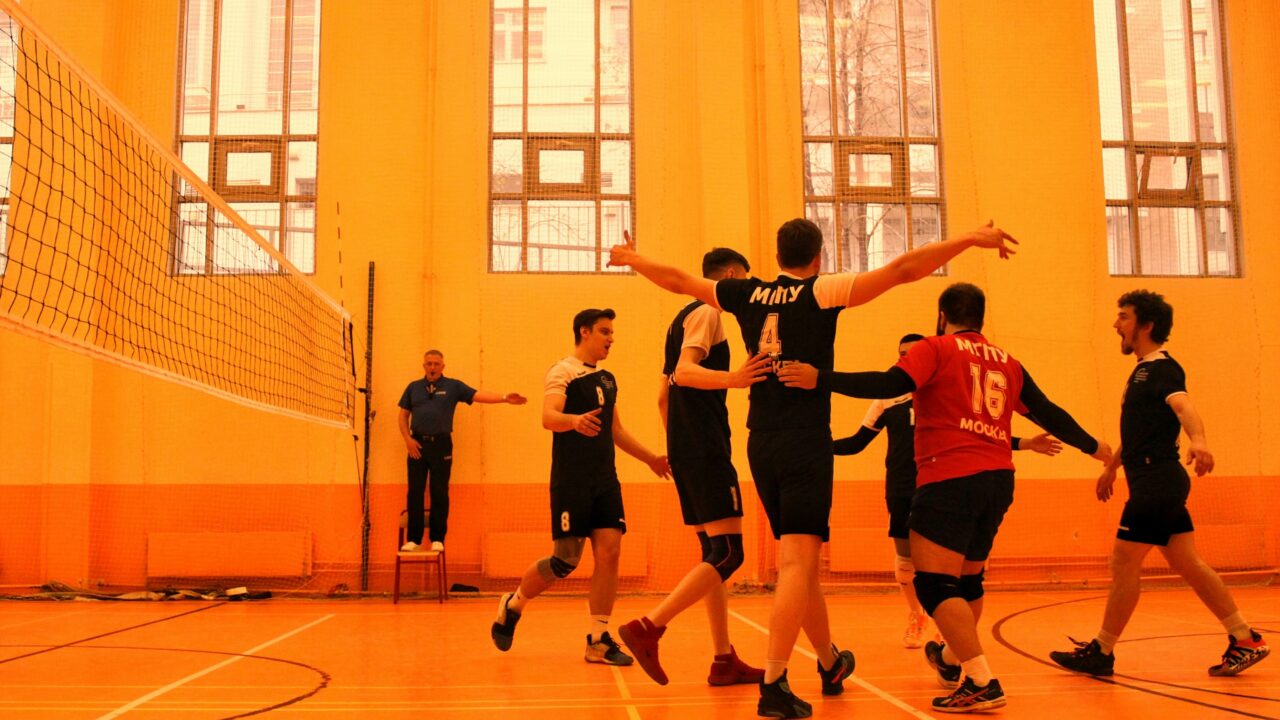
Most people hear “BYU” and think football, basketball, or the Honor Code. The fans who actually live in Provo know better: this is a volleyball school. The men’s program has three national championships. The women’s program has been to two title games and made the NCAA tournament 48 times. And the Smith Fieldhouse, the seventh-largest college volleyball venue in America, gets loud enough on a White-Out night to disorient visiting teams from the second they walk through the door.
Here’s a tour through everything that makes Cougar volleyball worth following — the championship history, the Big 12 reset, the rivalry that fills the building, and how fans are plugging into the new NIL era.
Three National Titles: The Men’s Dynasty
Between 1999 and 2004, BYU men’s volleyball did something no team outside California or Hawaii had done before: they won multiple NCAA championships. Three of them, actually, in a six-year stretch that put a school from the Mountain West firmly into the sport’s elite class.
- 1999 — Carl McGown’s first title. The Cougars went 30-1 and swept Long Beach State in the championship match. McGown was named AVCA National Coach of the Year.
- 2001 — McGown’s second. BYU beat UCLA 3-0 in the final, winning a championship “when the odds weren’t so much in our favor,” in McGown’s own words. He was named AVCA National Coach of the Year again.
- 2004 — Tom Peterson took over after McGown’s retirement and won the title in his first season — a 21-match win streak, 10 straight weeks ranked #1, and a five-set thriller over Long Beach State in the final. Peterson became the first men’s volleyball coach to win NCAA titles at two different schools (he’d also won at Penn State in 1994). Setter Carlos Moreno was named AVCA National Player of the Year, the first in program history.
The 1999 season also produced one of the great pieces of trivia in college volleyball: on February 19, BYU beat Hawaii 3-1 at the Marriott Center in front of 14,156 fans, still the NCAA single-match attendance record. Imagine an NBA arena packed for a regular-season volleyball match.
After Peterson came Chris McGown — Carl’s son — who took over in 2012 and won AVCA National Coach of the Year in 2013 while leading the Cougars to the NCAA final. The Chris McGown era was defined by Taylor Sander, a four-time First-Team All-American and the 2014 AVCA National Player of the Year, who went on to win bronze with Team USA at the 2016 Rio Olympics.
In fact, BYU men’s volleyball has produced a remarkable list of Olympic medalists. Ryan Millar and Richard Lambourne won gold at the 2008 Beijing Olympics. Taylor Sander added bronze in 2016. Three Olympic medals from a single mid-major volleyball program is the kind of stat that makes the championship history make more sense.
Since 2016, Shawn Olmstead has run the men’s program (after winning a national runner-up with the women’s team in 2014) and kept the Cougars near the top. His teams finished as NCAA runners-up in 2016, 2017, and 2021. The 2020 squad was ranked #1 in the nation when COVID canceled the season. Gabriel García Fernández added the third AVCA National Player of the Year honor in program history in 2020. The 2026 team went 21-12 overall, beat #4 Stanford in the MPSF Tournament quarterfinals, and lost to eventual #1 UCLA in the semifinals at home. BYU men’s volleyball stayed in the MPSF (Mountain Pacific Sports Federation) when the rest of the athletic department went to the Big 12 — because the Big 12 doesn’t sponsor men’s volleyball.
The defining men’s rivalry has long been against Hawaii. The 1999 attendance record at the Marriott Center was a Hawaii match. Decades later, they still play home-and-home series most years (Hawaii swept BYU in Honolulu in February 2026). Add UCLA, USC, Stanford, and Pepperdine to the rotation, and the MPSF schedule reads like a Who’s Who of the men’s volleyball world.
The Women’s Big 12 Era
BYU women’s volleyball is older than the men’s program and built on a different kind of legacy. The team has been to two national championship matches — losing the 1972 AIAW final and the 2014 NCAA final to Penn State. They’ve been ranked in the AVCA Coaches Poll 490 times since 1984, including 198 Top 10 weeks and 15 weeks at #1.
The foundational figure is Elaine Michaelis, who coached from 1969 to 2001, went 705-178-5, ran off 28 consecutive 20-win seasons, and in 1981 became the first female coach in the country to take a team to the NCAA Final Four. The court at Smith Fieldhouse is named after her.
Most of the 21st century was a continuous run of high-level finishes — Sweet Sixteens, Elite Eights, and a national runner-up year in 2014 under Shawn Olmstead. Heather Olmstead (Shawn’s sister-in-law) took over in 2015 and went 279-55 over 11 seasons, winning multiple WCC titles before the program moved to the Big 12 in 2023.
The Big 12 has been a real adjustment. The Cougars went 25-7 in their first conference season, then 19-10 and 22-9 in the next two — solid records, but third-place, sixth-place, and sixth-place conference finishes against a much deeper league than the WCC. As of 2026, the program is under new head coach Rob Neilson, who isn’t exactly a stranger in Provo — he ran the BYU men’s program for the 2011 season (20-8 record) before this return to the BYU volleyball family. His first women’s slate includes the Big 12 gauntlet (Baylor, Kansas, Kansas State, Houston, West Virginia, Arizona, Colorado, Arizona State, Iowa State, Texas Tech, Cincinnati, UCF, TCU) plus two matches against Utah — Oct. 15 in Salt Lake City and Oct. 30 at Smith Fieldhouse.
Smith Fieldhouse: 5,000 Strong
The Smith Fieldhouse opened in 1951 and has been the heart of BYU volleyball ever since. It seats 5,000, and the building’s tight footprint puts fans nearly on top of the court — every line judge, every serve, every dig is happening within shouting distance of someone in a blue T-shirt.
For context, Smith is the seventh-largest college volleyball venue in the United States. The single-game attendance record was set in 2023 against Utah at 5,528, which means BYU exceeded the official capacity by more than 500 for that game. That’s not a typo — when fans want in badly enough, they make space.
A visitor’s quick survival guide:
- The student section is called the ROC — short for Roar of the Cougars. They wear blue and white and they coordinate. White-Out and Blue-Out games are designated each season, and they fill the building.
- General admission seating for non-students is bleacher-style and first-come-first-served. Plan to arrive an hour before first serve if you want center-court.
- Free parking opens up at lots north of the indoor practice facility after 4 PM on game days.
- Postgame, players gather in front of the ROC to sing the fight song. Stick around for it — it’s one of the best traditions in college volleyball.
The Utah Rivalry
Forget any framing that puts Texas in a BYU rivalry conversation — Texas left for the SEC in 2024 and isn’t even in the Big 12 anymore. The rivalry that actually fills Smith Fieldhouse to overflowing is BYU vs. Utah. The two schools have hated each other in every sport for a century, and volleyball is no exception. That 5,528-fan attendance record in 2023? Utah game. The 2025 schedule? A circle on the calendar in Provo.
The annual Utah match has the feel of a small-arena rock concert — packed, loud, occasionally chippy, and almost always a national-television moment. If you can only get to one match per season, this is the one.
How to Watch
BYU has unusually deep broadcast coverage for a volleyball program. Four main pathways:
- BYUtv — the university’s own free network. Streams most home matches (men’s and women’s) at no cost, app and web.
- B1G+ / Big Ten Network — most men’s volleyball home matches and MPSF road games land here, since the Big Ten now anchors much of the men’s volleyball broadcast ecosystem.
- ESPN+ — most Big 12 women’s volleyball road games and some men’s MPSF road games. Subscription required.
- Live stats — the BYU athletics site runs free real-time kills, hitting percentages, and dig totals during every match.
If you can’t catch the broadcast, the live stats tracker is the next best thing — useful for fantasy-style obsession or just settling arguments.
The NIL Era: How Fans Get Involved
Name, Image, and Likeness has changed what it means to support a college program. Enrolled BYU student-athletes — including volleyball players — can now earn from compliant fee-for-service deals: sponsorships, social media work, appearances, and clinics. Utah is a state where NIL has been legally protected since 2021, and BYU’s combined Honor Code-meets-Big-12 environment has produced a distinct kind of athlete brand — disciplined, community-minded, and increasingly visible nationally.
Fans who want to support enrolled BYU volleyball athletes through compliant NIL engagements have a few sport-specific pathways on RallyFuel:
These aren’t recruiting tools and they aren’t direct payments to players. Each fan purchase is a conditional NIL engagement that converts into an NIL agreement only if an enrolled athlete voluntarily participates, with funds held by a licensed third-party payment processor during the conditional period — operating within NCAA rules and the new clearinghouse framework that reviews NIL deals for market value.
Why It Matters
BYU volleyball — both programs — sits in an interesting spot in 2026. The men still play for national championships every year, but they do it in a conference (MPSF) that’s geographically distant from the rest of BYU athletics. The women just lost an 11-year head coach (Heather Olmstead) and are rebuilding under Rob Neilson in their fourth Big 12 season. Both teams play in a building that feels like a 1950s relic until you’re inside it during a White-Out and the floor starts vibrating.
For Cougar fans, the appeal is the same as it’s always been: passionate crowds, programs that compete above their weight class, and a championship history that not many schools outside the sport’s traditional bluebloods can claim. The era around it keeps changing. The Smith Fieldhouse roar doesn’t.
Q&A
How many NCAA championships does BYU men’s volleyball have? Three: 1999 and 2001 under Carl McGown, and 2004 under Tom Peterson. BYU is the only men’s volleyball program outside California or Hawaii to win multiple NCAA titles. The coaching lineage continued with Carl’s son Chris McGown (2012-2015, including the 2013 NCAA Final), and current head coach Shawn Olmstead has added three more national runner-up finishes (2016, 2017, 2021). The program has also produced three AVCA National Players of the Year — Carlos Moreno (2004), Taylor Sander (2014), and Gabriel García Fernández (2020) — and three Olympic medalists: Ryan Millar and Richard Lambourne (gold, 2008) and Taylor Sander (bronze, 2016).
Has BYU women’s volleyball ever won a national championship? No, but they’ve come close. The Cougars finished as NCAA runners-up in 2014 and AIAW runners-up in 1972. The program has 48 NCAA tournament appearances and 32 conference championships — one of the most consistent women’s volleyball programs in the country, even without the trophy.
Why is men’s volleyball still in the MPSF when everything else is in the Big 12? Because the Big 12 doesn’t sponsor men’s volleyball. BYU’s men’s team has been in the Mountain Pacific Sports Federation (MPSF) since 1990 and stayed there when the rest of the athletic department moved to the Big 12 in 2023. That’s not unusual — men’s volleyball is a smaller sport with only a handful of major-conference sponsors.
Who’s the current women’s volleyball head coach? Rob Neilson, who took over in 2026 after Heather Olmstead’s 11-year run ended. Olmstead went 279-55 across her tenure and won AVCA National Coach of the Year in 2018. Neilson isn’t new to BYU volleyball — he ran the BYU men’s program for the 2011 season (20-8) before returning now to lead the women’s side.
Where do I sit at Smith Fieldhouse, and when should I arrive? General admission seating is bleacher-style and first-come-first-served. Arrive at least 60 minutes early for center-court bleacher seats. Avoid the baseline corners where the referee stand can block sightlines. The ROC student section runs the loud end of the building, and free parking opens up after 4 PM in the lots north of the indoor practice facility.