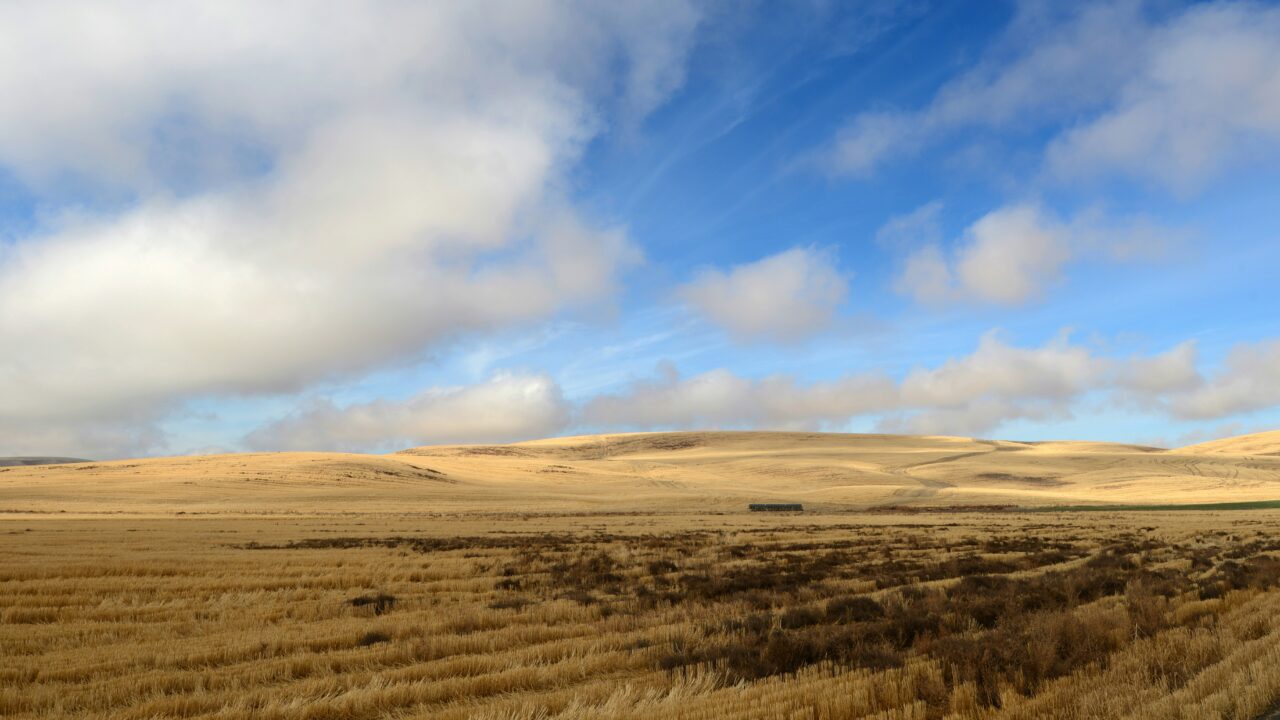
Drive the back roads of the Palouse in autumn and the land does something strange to your sense of distance. The wheat runs to the horizon in long golden swells, broken only by the occasional grain elevator, and two college towns sit so close together you could stand on one campus and practically wave at the other. Moscow, Idaho and Pullman, Washington are less than eight miles apart. A paved trail runs between them. You can walk it.
Most college rivalries are built on distance and difference. This one is built on the opposite problem. Two land grant universities, founded to serve two different states, planted almost on top of each other along a border that runs through a wheat field. They have been playing each other since 1894, and the only real question the rivalry has ever asked is which side of that line gets to feel good on Monday.
This is the Battle of the Palouse, the Idaho Vandals against the Washington State Cougars, and it manages to be one of the closest and most lopsided rivalries in the country at the same time.
Table of Contents
- One Wheat Field, Two States
- A Wildly Lopsided Ledger
- The Fires and the Displaced Bowl
- How Football Faded and Basketball Took Over
- Where It’s Played, and Why That Matters
- The Series Beyond the Marquee
- The Current State of Things
- How Fans Are Fueling This Rivalry Off the Field
- Why It Endures
One Wheat Field, Two States
The geography is the whole story. Idaho‘s campus in Moscow sits nearly on the state border, and Washington State is directly west in Pullman, the two linked by a single state highway and the Bill Chipman Palouse Trail. They are land grant schools built for neighboring states that happen to share a county’s worth of farmland and almost everything else: the same weather, the same recruiting backyard, the same wheat.
For thirty years that closeness produced one of the best traditions in college sports. From 1938 to 1968 the schools ran a Walkathon: a week after each game, students from the losing school walked the miles to the winner’s campus, then caught rides home from the people who had just beaten them. In 1954, when the Cougars lost to Idaho for the first time in twenty nine years, roughly two thousand Washington State students made the trek east to Moscow, and it landed in the national news. That is the rivalry in a single image. Close enough that the penalty for losing was a walk across the county.
A Wildly Lopsided Ledger
It would be generous to call the football series competitive. Washington State leads it 74–17–3, a winning percentage above .800, and the record since 1926 is even more brutal. The Cougars once beat Idaho more than twenty straight times across the 1930s and 1940s, and went unbeaten against them across twenty six meetings from 1926 to 1953. Their largest win was an 84–27 demolition in 1975. They have won the last eleven in a row dating to 2001. Idaho’s best stretch in the entire history of the rivalry was three straight wins in the mid 1920s, and the Vandals have only managed a small handful of victories since.
Which is exactly why Idaho‘s rare wins are the treasures of the series. The Vandals’ first forward pass in program history was thrown against the Cougars in 1907, a fourth quarter touchdown out of a drop kick formation that delivered a 5–4 win. And then there is the game that never happened: in 1898 Idaho turned up with a ringer, a recent All American named David McFarland brought in from Carlisle, and the matchup was simply scrapped. A rivalry this uneven keeps its drama in the margins.
The Fires and the Displaced Bowl
Then there is the strangest chapter, when both schools nearly lost the ability to host the game at all. Within five months, from November 1969 to April 1970, the two aging wooden stadiums on the Palouse burned to the ground, Idaho’s Neale Stadium and Washington State’s Rogers Field, both fires suspected arson.
The 1970 game had nowhere to go, so it became the Displaced Bowl, relocated to Joe Albi Stadium in Spokane and played on artificial turf for the first time in the rivalry’s history. Washington State won it, the only victory in an otherwise miserable season, and then won the next ten in a row for good measure.
How Football Faded and Basketball Took Over
The thing that finally pulled the football rivalry apart was not bad blood but a rule change. In 1978 the NCAA split its top football level in two. Washington State stayed in the upper tier, now called FBS, inside a power conference. Idaho dropped to the level now called FCS and joined the Big Sky. For most of the next two decades the two barely played football at all, meeting just twice between 1979 and 1997. Football has been an intermittent thing ever since.
But basketball nearly never stopped. Idaho and Washington State played men’s basketball every year from 1906 onward, the longest continuously contested basketball series in the country, and the floor is where the rivalry truly lives. Washington State leads it 168–115, yet the games are genuine, and they have given the rivalry its best modern theater. The peak came in the early 1980s, when Idaho’s Don Monson and Washington State’s George Raveling went head to head. A December 1982 overtime win packed eleven thousand fans into the Kibbie Dome for an Idaho team ranked in the national top ten and headed for the Sweet Sixteen.
The one thing that finally interrupted it was, fittingly, paperwork. After the 2021 meeting, a rule in Washington State’s conference that discouraged its teams from scheduling opponents ranked too low in the NCAA’s NET metric got in the way, the two sides could not agree on a game for 2022, and the longest running basketball rivalry in the country quietly stalled after one hundred and fifteen years. It returned in 2023 and has been played every season since.
Where It’s Played, and Why That Matters
Here is the quiet injustice of being eight miles apart: the football game almost never happens on Idaho’s side. Since the rivalry was rebuilt in 1998, every football meeting has been played at Washington State’s Martin Stadium in Pullman, with a single exception in Seattle in 2003. The last time the football game was contested on the Idaho side of the border was 1966, a muddy 14–7 Cougar comeback. That is sixty years of one team hosting.
Basketball was always the corrective. For more than a century the hoops series alternated between Moscow and Pullman the way a rivalry between close neighbors should. Lately even that has tilted: the game has not been played in Moscow since 2021, when the Cougars won by a series record margin of 109–61, and every meeting since the 2023 revival has been staged in Pullman. That is about to change, which is part of the current story.
The Series Beyond the Marquee
The Palouse rivalry has touched almost every sport on campus. In women’s basketball, Washington State leads 26–13, though the programs have not met since 2008. In soccer, which Idaho only launched in 1998, the Cougars have won eleven straight, with the lone Vandal victory coming in the very first meeting in 1999. In volleyball, Washington State leads 44–21 in a series that dates to 1976.
Baseball was at its best in the 1960s, and although Idaho dropped the sport after 1980, the Vandals went out on top, winning the final meeting and ending a Washington State unbeaten run that had reached forty two games. Even boxing belonged to the rivalry once, back when both schools fielded national programs and a single dual meet could draw five thousand people. Sports came and went. The rivalry absorbed all of them.
The Current State of Things
Football remains a Washington State possession. The Cougars won the latest meeting 13–10 on August 30, 2025 in Pullman, stretching their winning streak to eleven, and the two are not scheduled to play football again until September 4, 2027.
Basketball, as usual, told a different story. Two months later, on November 3, 2025, Idaho walked into Pullman and won 83–81, and the timing could hardly have been better for the Vandals. That season they went on to win the Big Sky Conference Tournament and reach the NCAA Tournament for the first time in thirty six years, while Washington State, rebuilding its roster for life in a restructured conference, finished 12–20.
And the rivalry is about to get healthier. In June 2026 the schools agreed to bring the basketball series to both campuses over the next two seasons: Washington State will host Idaho at Beasley Coliseum on November 27, 2026, and Idaho will host the Cougars at its new ICCU Arena the following season, returning the game to Moscow for the first time since 2021. The football ledger belongs to Washington State and may for a long time. The basketball floor is where Idaho keeps the fight alive, and now both sides have signed up to keep showing up for it.
How Fans Are Fueling This Rivalry Off the Field
The scoreboard settles Saturdays. Increasingly, the fanbases are settling something else.
In the NIL era, backing a program means more than a ticket and a voice. Platforms like RallyFuel let fans support individual athletes directly through verified, compliant NIL deals, choosing which players to fund, following their real performance stats, and turning loyalty into something measurable. Both sides of the Palouse have a home there: Vandals fans gather at Idaho and Cougars fans at Washington State.
It adds a second contest to a rivalry built on proximity. RallyFuel’s Fan Power Rankings measure a fanbase’s energy (fans, fire ups, Rally Pit activity, and posts), while the schools leaderboard ranks programs by total support from fans. For two schools eight miles apart, where the football series has tilted one way for decades, the question of which fanbase shows up hardest off the field is one with a live, trackable answer, and unlike the football game, it does not have to wait until 2027.
Why It Endures
Proximity is the answer to everything here. Two schools that share a wheat field, a trail, a climate, and a pool of local fans cannot stop being aware of each other, no matter how lopsided the scoreboard gets. The football series is one of the most uneven in the country, and it survives anyway, because eight miles is too close to ignore and a state line is too real to forget.
The Walkathon is gone. The stadiums that burned were rebuilt. Baseball and boxing came and went. And the rivalry migrated to the basketball floor and kept going, the way it had nearly every winter since 1906. Idaho will keep hunting the rare win that means everything. Washington State will keep being favored and keep having to prove it. And the trail between the two campuses will stay open, eight miles of wheat between two states that were never going to be quiet neighbors.