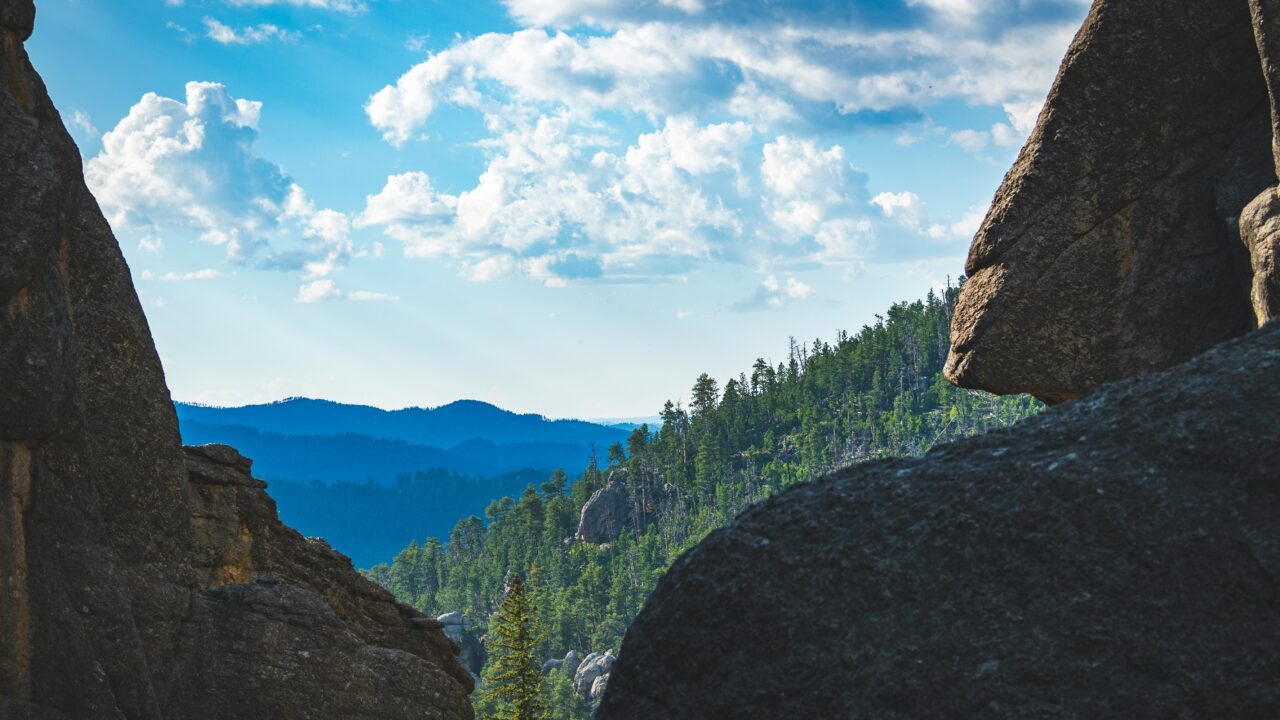
Ask a college football fan to name the most played rivalries in the country, and the answers come easily at the top: Harvard and Yale, Princeton and Yale, Lafayette and Lehigh. Almost nobody gets to number four. It is not in the Ivy League or the old industrial Northeast. It is in the Black Hills of western South Dakota, where two small schools about fifty miles apart have been playing each other since the 1890s for a trophy named after a gold mine.
This is the Black Hills Brawl, the football rivalry between Black Hills State University and the South Dakota School of Mines and Technology. It is the most played rivalry in all of Division II, the oldest football series west of the Mississippi River, and the fourth most played game in the entire sport, trailing only three of the most famous rivalries in the East. And for most of the people who fill the stands every fall, it is simply the only game that matters.
Table of Contents
- The Fourth Most Played Game in the Country
- A Trophy Named for a Gold Mine
- Two Schools, Two Worlds
- A Century of Back and Forth
- How Fans Are Fueling This Rivalry Off the Field
- Why It Endures
The Fourth Most Played Game in the Country
The numbers are the easiest place to start, because they are genuinely startling for two schools this size. Black Hills State and South Dakota Mines have met 140 times, a total that puts them behind only Harvard and Yale, Princeton and Yale, and Lafayette and Lehigh on the all time list. They have played every single year since 1946. The series is usually traced to 1895, though that first game was a strange one, contested against a small local college that has since vanished, and the two schools count their official rivalry from 1900 instead.
That makes it not only the most played rivalry in Division II but, by most reckonings, tied for the oldest. None of this was built on national stakes. For most of their histories both were small college programs, and they only climbed up to Division II in the last fifteen years or so. The rivalry is older than the division it now belongs to, older than the conference, older than nearly everything around it. South Dakota Mines leads the series by the slimmest of margins, 67–62–11, which after 140 games and 130 years means neither side has ever truly pulled away.
A Trophy Named for a Gold Mine
The prize is the Homestake Trophy, and it is adorned with a prospector’s pan, which is about the most South Dakota thing a trophy could possibly be. It is also, by local reputation, dangerously heavy, the sort of hardware that can bruise a careless winner who lifts it wrong. It is named for the Homestake Mine in nearby Lead, and the choice was not arbitrary. The Homestake was the richest gold strike in American history.
Discovered in 1876 during the Black Hills gold rush and soon bought up by the mining baron George Hearst, the Homestake produced something close to a tenth of the world’s gold over the next 125 years. It was the largest and deepest gold mine in the Western Hemisphere, descending some 8,000 feet into the hills, and it ran continuously until 2001, when it finally closed. In an unlikely second act, the emptied mine became one of the most important physics laboratories in the world, a place buried deep enough to catch neutrinos streaming from the sun.
A trophy named for that mine fits this rivalry perfectly, because the gold rush is the reason these schools exist at all. One of them is literally a school of mines. Its teams are the Hardrockers, named for the men who blasted ore out of the Black Hills, and its mascot is Grubby the Miner.
Two Schools, Two Worlds
For a rivalry built on proximity, the two schools could hardly be more different. South Dakota Mines, in Rapid City, is an engineering and science research university, the kind of place that once made national news when a business report found its graduates starting their careers on higher salaries than Harvard’s. Black Hills State, about fifty miles northwest in Spearfish, is a liberal arts university with a very different feel. One campus turns out petroleum engineers and physicists; the other turns out teachers, artists, and business graduates.
They share a region, though, and in this part of the state that counts for everything. Both sit in the Black Hills, west of the Missouri River, in the stretch of South Dakota that locals call West River. There is no third option nearby, no bigger program down the road to pull attention away. When the Yellow Jackets and the Hardrockers play, the whole region picks a side. The contrast even flavors the trash talk, with the future engineers from Mines fond of reminding their rivals that they will all be working for them someday. The rivalry runs through every sport the two schools share, and in 2026 it even reached the ice, when Rapid City’s professional hockey team staged a Black Hills Brawl night with the two programs’ colors.
A Century of Back and Forth
The football has moved in long tides. South Dakota Mines dominated the early decades, winning eighteen of the first twenty meetings, including a 1917 season in which the schools played three times and Mines won all three. Black Hills State surged back in the late 1920s and 1930s, and again in a long run around the turn of this century. The lead has changed hands so often that the all time margin has stayed razor thin for a hundred years.
The games themselves have delivered their share of drama. Black Hills State once won 58–0, the largest margin in the series. South Dakota Mines took a 2010 classic in double overtime, tying it on a field goal with two seconds left before winning in the second extra period. The 2025 meeting, the 140th, was played in pouring rain in Spearfish, where Mines fell behind early and then reeled off 24 unanswered points to win 27–13, taking home both the Homestake Trophy and a one game edge in a series that has rarely let either side hold much more than that. The two will line up again in 2026 in Rapid City.
How Fans Are Fueling This Rivalry Off the Field
A rivalry that has survived 130 years on regional pride rather than national television is exactly the kind that lives or dies on how much its people care. Both schools already lean into that. The week leading up to the game, known as Brawl Week, includes a giving challenge in which the two fan bases compete to raise the most money for their own student athletes, turning the rivalry itself into a fundraiser.
In the NIL era, backing a program means more than a ticket and a voice. Platforms like RallyFuel let fans support individual athletes directly through verified, compliant NIL deals, choosing which players to fund, following their real performance stats, and turning loyalty into something measurable. That reach runs all the way through Division II, where rosters are built on grit rather than big budgets and a few hundred dollars of fan support can change an athlete’s season. Both programs have a home there: Yellow Jackets fans gather at Black Hills State and Hardrockers fans at South Dakota Mines.
RallyFuel’s Fan Power Rankings measure a fan base’s energy (fans, fire ups, Rally Pit activity, and posts), while the schools leaderboard ranks programs by total support from fans. For two fan bases that have shown up for this game every year since 1946, turning that loyalty into something their athletes can use is a natural next step.
Why It Endures
The Black Hills Brawl endures for the simplest reason in sports: two schools close enough to know each other, far enough apart to want to win, and a century of history that neither side is willing to be the one to break. It does not need a championship on the line. It has a gold pan trophy, a mining town and a college town that have been arguing since before South Dakota was paved, and a series record so close that every game genuinely moves it.
Somewhere out west, past the Missouri River and up into the hills where the Homestake once pulled a tenth of the world’s gold from the ground, two small schools will line up again this fall in the fourth most played rivalry in the country. Most of America will never notice. In the Black Hills, it will be the only thing anyone is talking about.