The last Saturday of November belongs to two states. Everything else stops. The stores close early. The living rooms divide. Somewhere in Ohio, a man is taping over the letter M on his garage door. Somewhere in Michigan, someone is refusing to acknowledge the word “Ohio” without the definite article that precedes it. This is The Game — a proper noun that needs no further identification within three hundred miles of the Michigan–Ohio border, and very little beyond it.
Michigan leads the all-time series 62–52–6. Ohio State has won 18 of the last 25. Both fanbases will tell you these numbers mean everything. Both are right, and neither is satisfied.
A Border Dispute That Never Ended
The hostility between Ohio and Michigan predates football by 62 years. In 1835, both governments mobilized armed militias over a 468-square-mile strip of land near the current state line that included access to a critical Lake Erie port. The standoff became known as the Toledo War. No one died — the single documented injury came when an Ohioan named Two Stickney stabbed Monroe County Deputy Sheriff Joseph Wood with a penknife during a tavern brawl; Wood fully recovered — but the diplomatic damage was permanent.
Congress settled it in December 1836 by awarding the port city to Ohio and granting Michigan statehood along with the western three-quarters of the Upper Peninsula. Michigan entered the Union in 1837 harboring a grievance that has been passed down more reliably than most family heirlooms. The football series began in 1897, which gave both states a legal, organized way to continue the argument. They have played annually since 1918, with only two exceptions: 1917, before Michigan rejoined the Big Ten, and 2020, when Michigan canceled due to a COVID-19 outbreak. The Ohio State alma mater “Carmen Ohio” was written on the train ride home to Columbus following the 1902 game, which Michigan won 86–0. The lyrics have remained largely unchanged since.
The Series and What It Means
Michigan dominated the early series ruthlessly. Fielding Yost’s 1901–1905 “point a minute” teams outscored Ohio State 214–6 across five meetings. Michigan compiled a 12–0–2 record from 1897 to 1912. Once both schools were Big Ten members and playing annually from 1918 onward, Ohio State started closing the gap.
The modern psychological framework of the rivalry was built in 1934. Michigan had dominated so thoroughly that Ohio State players approached the game with something close to dread. New head coach Francis Schmidt addressed his nervous locker room directly: “Michigan puts their pants on one leg at a time, just like the rest of us.” Ohio State won 34–0, then outscored Michigan 114–0 over the next three seasons. A Columbus business group commemorated Schmidt’s speech by commissioning small gold lapel pins shaped like football pants, awarded to every Ohio State player who beat Michigan. The Gold Pants Club has been issuing them since 1934 — a piece of jewelry worth nothing financially that grown men who have signed NFL contracts still wear at public appearances, because in a rivalry this deep, the symbolic wins are the ones that last.
Ohio State holds a 52–50–4 lead in Big Ten conference play specifically. Michigan leads the all-time overall series. That distinction is where most arguments between fans currently live.
The Snow Bowl and Woody Hayes
One of the more famous games before the Ten Year War era came in 1950, known as the Snow Bowl. Eighth-ranked Ohio State, coached by Wes Fesler, hosted Michigan during one of the worst blizzards in Ohio history. The Buckeyes — who led the Big Ten and held the option to cancel the game, which would have given them the conference title by default — refused to cancel. In the howling snow, both teams punted 45 times total, often on first down, trying to trap the opponent near their own end zone. Ohio State’s Vic Janowicz, that year’s Heisman Trophy winner, punted 21 times for 685 yards. Michigan capitalized on two blocked punts and won 9–3 without completing a single forward pass or gaining a single first down. The loss led directly to Fesler’s resignation and the hiring of Woody Hayes.
Between 1951 and 1968, Hayes won 12 of 18 contests against Michigan. After a 50–14 win in 1968, Hayes was asked why he went for two points with an already insurmountable lead. He replied: “Because they wouldn’t let me go for three.”
The Ten Year War
The game became mythological between 1969 and 1978, during the decade defined by Woody Hayes of Ohio State and Bo Schembechler of Michigan.
Hayes was a military historian who viewed football as literal combat and famously refused to buy gasoline in the state of Michigan on principle. He coined the phrases “That team up north” and “That state up north” so he would never have to say the word Michigan. Schembechler had been his assistant at Ohio State for years, learning his schemes, absorbing his methods, and figuring out precisely what made him tick. When Schembechler took the Michigan job in 1969, Hayes understood immediately what was coming.
Ohio State entered the 1969 game as defending national champions, undefeated, riding a 22-game winning streak. Behind a 60-yard punt return by Barry Pierson that set up a touchdown, and three interceptions by Pierson alone, Michigan won 24–12. The second half was scoreless.
Over their ten meetings, Schembechler won five, Hayes won four, and they tied once. Nearly every game decided the Big Ten Conference championship and a Rose Bowl berth. In 1973, both teams entered undefeated, played to a 10–10 tie in Ann Arbor, and the Big Ten athletic directors held a secret ballot to determine the Rose Bowl representative. Ohio State won the vote. Michigan newspapers were flooded with angry letters for months.
Hayes was fired in January 1979 after punching Clemson linebacker Charlie Bauman during the Gator Bowl. Schembechler’s final record against Hayes was 5–4–1. By the time the rivalry resumed without Hayes, its psychological infrastructure was permanent.
The Moments That Define It
1950 — The Snow Bowl: Michigan won 9–3 without completing a pass or gaining a first down. 45 combined punts. A blizzard. The game that ended Fesler’s career and brought Hayes to Columbus.
1969: Michigan 24, Ohio State 12. The upset that launched a decade of warfare.
1993: Michigan 28, Ohio State 0. Ohio State entered 9–0–1 with a Big Ten title in reach. Michigan shut them out. Cooper said: “If you’d told me we would come up here and get beat 28–0, I’d have probably stayed home.”
1995: Michigan 31, Ohio State 23. No. 2 Ohio State, led by Heisman winner Eddie George, entered undefeated. Tim Biakabutuka rushed for 313 yards. Cooper’s record fell to 2–10–1.
2001: Ohio State 26, Michigan 20. Jim Tressel publicly promised at a January basketball game that his team would make fans proud against Michigan in 310 days. He delivered.
2006: Ohio State 42, Michigan 39. No. 1 vs. No. 2. Bo Schembechler died the morning before kickoff. The game averaged 21.8 million viewers.
2021: Michigan 42, Ohio State 27. Hassan Haskins scored five touchdowns — a series record. It ended Michigan’s eight-game losing streak against Ohio State.
2022: Michigan 45, Ohio State 23. Both teams undefeated. The broadcast drew 17 million viewers, the highest in Fox Sports history.
2023: Michigan 30, Ohio State 24. Both teams undefeated again. Harbaugh suspended; Moore coached. Third straight Michigan win. 19.1 million viewers, peaking at 22.9 million — a record for the series. Michigan went 15–0 and won the national championship.
2024: Michigan 13, Ohio State 10. Unranked Michigan, 6–5, as 20.5-point underdogs. Dominic Zvada’s 21-yard field goal with 45 seconds left. After the game, Michigan players planted their flag at Ohio State’s midfield logo. Buckeyes players pursued them. Pepper spray. $100,000 fines for both schools. Ohio State went on to win the national championship — the first time the two rivals won consecutive national titles.
2025: Ohio State 27, Michigan 9. No. 1 Ohio State, 11–0. Julian Sayin threw three touchdown passes, 233 yards. Michigan held to 163 total yards. Brutus Buckeye crossed out the M in a snow-covered end zone and wrote “Ohio” in cursive. Ryan Day: “Humility.”
The Rituals
On the Tuesday night before The Game, thousands of Ohio State students jump into Mirror Lake regardless of temperature. What began as a spontaneous act in the early 1990s has become one of the most reliably attended rituals in American college sports.
The Ohio State University Marching Band — The Best Damn Band in the Land — performs Script Ohio before home games, spelling out the word in cursive across the field in a single-file line dating to 1936. The routine ends when a fourth-year sousaphone player high-steps to the dot of the “i” and bows.
In Columbus during rivalry week, the letter M is covered on street signs with red tape. Hayes refused to speak Michigan’s name. Michigan fans respond by referring to Ohio State as “THE Ohio State University” with withering emphasis on the definite article.
The Stadiums
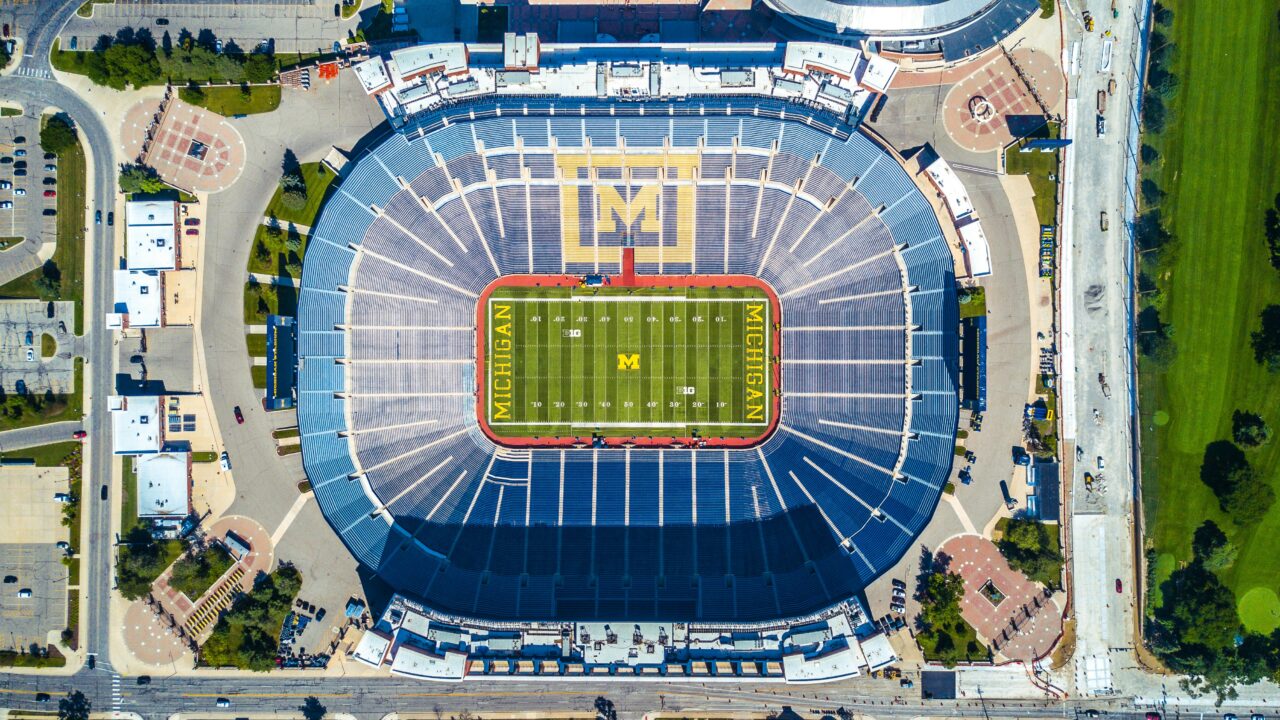
Michigan Stadium — The Big House — holds 107,601 fans in a sunken bowl design that looks modest from street level and reveals itself only once you pass through the gates. It held the first college football game attended by over 100,000 fans in 1957.
Ohio Stadium — The Shoe — stands above the Columbus campus like a horseshoe-shaped monument, topped by a stained-glass Rotunda at the main entrance. It holds over 102,000 fans. The steep upper decks trap crowd noise and reflect it directly downward onto the field. The 1922 dedication game was played here against Michigan, which won 19–0. According to lore, yellow flowers on a blue background still exist today in the upper Rotunda from a wager on that game.
Three Big Ten schools — Michigan, Penn State, and Ohio State — have football stadiums seating over 100,000, a distinction no other conference can claim.
Two States, Two Athletic Identities
The rivalry runs deeper than football. Both states have produced Olympic athletes at a rate that shapes the culture of both universities and gives each program a distinct identity beyond the gridiron.
Ohio’s Olympic sports legacy centers on wrestling and fencing — disciplines where Ohio State has been a consistent national powerhouse. Over 200 Buckeyes have represented their countries in the Olympics, winning 77 medals combined. The most iconic is Jesse Owens, who won four gold medals at the 1936 Berlin Games in one of the most politically charged Olympic moments in history. That legacy shapes Ohio State’s self-understanding as a program that produces complete athletes, not just football players, and it influences how the athletic department builds its NIL infrastructure and recruiting narrative across every sport.
Michigan’s Olympic sports heritage flows through ice hockey, figure skating, swimming, and track. The Wolverines have nine NCAA Men’s Ice Hockey Championships and are a perennial contender in the NCAA Frozen Four. The depth of Michigan’s multi-sport athletic culture — a program with one of the largest and most engaged alumni networks in collegiate sports — gives the Ann Arbor NIL market distinctive commercial leverage beyond football alone.
NIL, The Laws, and How Fans Are Now Part of It
The Big Ten is the oldest conference in the nation, founded in 1896, with a revenue sharing cap of $20.5 million per school for 2025–26, football programs receiving roughly 75 percent. Big Ten NIL budgets rank among the highest in the nation, with athletes earning through a mix of revenue sharing and third-party deals.
Ohio State’s NIL operation is the largest in college football by disclosed numbers — approximately $20 million distributed to athletes in a single year, believed to be the highest total in the sport. Ohio State fans can back Buckeye athletes directly through RallyFuel, and the program sits No. 1 on RallyFuel’s schools leaderboard. Ohio’s NIL legal framework, detailed in RallyFuel’s guide to Ohio NIL laws, gives college athletes broad rights to earn from endorsements, appearances, and social media — with no institutional earning cap under state law and required disclosure to the athletic department within 30 days of any agreement exceeding $600.
Michigan’s NIL strategy runs through the Champions Circle collective, which pools fan resources through subscription-style memberships to pay players for community appearances and endorsements. Michigan NIL deals operate under Michigan’s own state legal framework, covered in RallyFuel’s guide to Michigan NIL laws, which gives Wolverines athletes the same fundamental rights to monetize their name, image, and likeness. Michigan fans can back Wolverines athletes directly through RallyFuel.
RallyFuel’s weekly college football predictions game lets fans earn points and direct them toward NIL support, and the Trophy Case tracks Heisman contenders throughout the season — Ohio State has seven Heisman winners, Michigan three, with Julian Sayin’s 2025 performance generating serious discussion.
Why It Endures
ESPN ranked this rivalry the greatest in North American sports in 2000. Encyclopaedia Britannica lists it among the ten great sports rivalries in history. The 2023 game averaged 19.1 million viewers and peaked at 22.9 million.
Michigan leads 62–52–6. Ohio State leads since 2000. Both teams won national championships in back-to-back years for the first time in 2023 and 2024. The 2024 postgame brawl ended with pepper spray and $100,000 fines. The 2025 game ended with Ohio State fans chanting in the Big House and Brutus writing cursive in a snow-covered end zone.
The Toledo War ended in 1836. The argument about who got the better deal has never stopped. Michigan leads overall. Ohio State leads recently. Neither side is satisfied. See you in November.