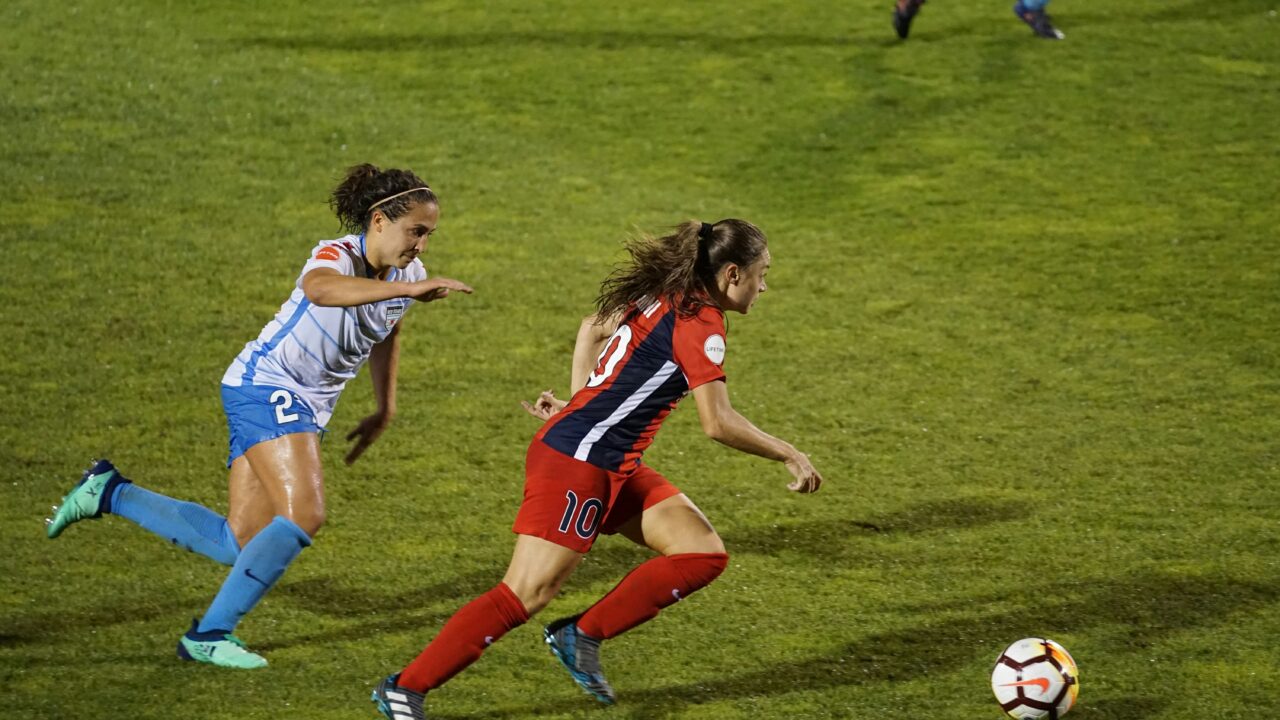
In December 2021, Nike made its first-ever NIL signing across all of college sports. The athlete wasn’t a quarterback. She was a forward at UCLA: Reilyn Turner.
That moment was supposed to signal the start of a wave. Four years and one massive antitrust settlement later, the reality for women’s college soccer NIL is more complicated. A small number of players have signed life-changing deals with Nike, Adidas, and global brands. Most haven’t. The average women’s soccer player at a Group of Five school earns around $1,425 per year in NIL income, while top earners like Texas’s Lexi Missimo command projected six-figure deals through alumni collectives and major talent agencies.
The gap between those two realities is the real story of women’s college soccer NIL. This is what the landscape actually looks like, who has broken through and how, and what the post-House-settlement era means for the players coming up next.
Table of Contents
- Summary
- The Real State of Women’s Soccer NIL
- The Standout Deals: Who Has Broken Through and How
- The Youth NIL Wave Changing the Pipeline
- The House Settlement and What It Means for Women’s Soccer
- Value and Leverage: A Framework for Players
- Where to Learn More
- Q&A
Summary
The vast majority of college NIL funding still flows to football and men’s basketball. Per Opendorse data, 73.5% of Division 1 NIL compensation goes to male athletes. Women’s soccer sits in the “non-revenue sport” category alongside most Olympic sports, which means total dollars are limited, and the dollars that exist are concentrated at the very top of the market. A handful of standout players have signed major deals with Nike, Adidas, and other global brands. A larger group earn modest income through local partnerships, collective contracts, and social media deals. Most players, even at top D1 programs, are earning little or nothing through NIL. The June 2025 House settlement, which now allows schools to directly pay athletes through revenue sharing, may widen this gap further unless schools intentionally allocate funds to women’s sports. This article covers what the landscape actually looks like, profiles the players who have broken through, and offers a framework athletes can use to identify and activate their own NIL value.
The Real State of Women’s Soccer NIL
The honest reading of the women’s soccer NIL market in 2026 is that money is scarce, and where it exists, it’s concentrated at the top.
The clearest number to start with: 73.5% of NIL compensation among Division 1 athletes goes to men, per Opendorse data. The remaining 26.5% gets distributed across every women’s sport — basketball, gymnastics, softball, soccer, volleyball, and dozens of others. Within that smaller pool, women’s basketball and gymnastics dominate the highest-value individual deals (think Paige Bueckers, Olivia Dunne), leaving women’s soccer to compete for what remains.
A few additional data points worth knowing:
- Women’s soccer players at Group of Five schools average around $1,425 in annual NIL earnings, per Washington Post reporting
- Top earners like Texas forward Lexi Missimo have leveraged alumni collectives such as the Texas One Fund and representation from major agencies (WME) to secure projected six-figure NIL totals
- On3’s NIL valuations regularly place top NCAA women’s soccer players in the tens of thousands of dollars in projected value, though most players are valued well below that
- In 2024, This is Sparta!, an NIL collective tied to Michigan State, signed a team-wide deal with the Michigan State Women’s Soccer team that paid each athlete $2,500 in January and an additional $5,000 the following fall — one of the more equitable distribution models in the sport
The pattern is clear: for women’s soccer players, NIL works very differently than it does for football and men’s basketball at the same schools. There are no eight-figure quarterback deals. The biggest opportunities flow to a small group of national-team-caliber players or athletes with large existing social media followings. Most players need to manufacture their own opportunities through local partnerships, group deals, or collective contracts.
Proven Sports Management, a women’s-soccer-focused agency, puts it bluntly in their 2025 analysis: “very little NIL money is being allocated to women’s soccer and opportunities tend to arise under very limited circumstances.”
The Standout Deals: Who Has Broken Through and How
A handful of women’s soccer players have signed deals that defined the early NIL era. Looking at how they did it offers a roadmap.
Reilyn Turner (UCLA): Nike’s first college NIL deal in any sport. When NIL took effect in 2021, Nike chose a women’s soccer player at UCLA for its first college signing across all sports — not a football or men’s basketball star. Turner’s combination of program (UCLA’s storied women’s soccer history), market (Los Angeles), and trajectory made her the right athlete for a brand defining its college NIL strategy.
Mia Bhuta (Stanford): Adidas signing and back-to-school campaign. Bhuta signed with Adidas as a first-year student at Stanford. As the first Indian-American soccer player to compete for the US women’s team at the FIFA World Cup level, she brought representation and a national audience that aligned with Adidas’s brand priorities. She appeared in their back-to-school campaign.
Ally Sentnor (UNC) and Savy King (UNC): Nike signings. UNC’s deep women’s soccer program produced two Nike NIL signings within months of each other. Both leveraged U-20 Youth National Team experience and UNC’s national visibility. Sentnor also worked with UNCUT, UNC’s student-athlete storytelling platform — an example of layering school-affiliated content opportunities on top of brand deals.
Ally Lemos (UCLA): Adidas, plus first female athlete signed by Steinberg Sports & Entertainment. Lemos signed her Adidas deal entering her second season at UCLA. The bigger story is that she was the first female athlete signed by Steinberg Sports & Entertainment, a long-established sports management agency. Securing major-agency representation as a women’s soccer player remains rare and meaningfully expands deal-flow.
JaNiya Stevens (UT Chattanooga): VfL Wolfsburg — first European pro club NIL deal. Stevens, a junior forward at a non-Power 4 school, became the first US college athlete signed by a European pro club. German Bundesliga side VfL Wolfsburg made her the face of their StrongHER U program. The takeaway: NIL opportunities can come from outside the traditional US brand market, and they don’t require playing at a top program.
Florida Gators (group deal with Athlicity). Five Florida soccer players — Josie Curtis, Lauren Donovan, Lauren McCloskey, Ashley Tutas, and Madison Young — signed a group deal with Athlicity, a Gainesville-based fitness apparel brand. The combined Instagram and TikTok reach across the five players (more than 56,000 followers total) made the group more valuable to the brand than any individual would have been alone. Group deals like this are a smart structural answer to the “individual following isn’t quite big enough” problem.
Michigan State Women’s Soccer (collective deal). Through This is Sparta!, an NIL collective, the full MSU women’s soccer team signed a roster-wide deal — $2,500 per athlete in January, $5,000 in the fall. Collective-driven team deals are one of the most equitable NIL structures in the sport.
The proactive approach: Julia Scoles (USC beach volleyball). Worth surfacing as a model from a parallel sport: USC beach volleyball player Julia Scoles, with a modest ~11,000 social media following, DM’d brands directly and landed an ambassador deal with Free People activewear. The lesson generalizes: athletes who aren’t being recruited by brands can recruit brands themselves. Many of the most successful women’s soccer NIL deals at non-elite levels start with the athlete sending the first message.
What these deals have in common: they were all designed around specific value propositions (national team identity, regional reach, group economics, international brand-building, proactive outreach) rather than raw social media follower counts.
The Youth NIL Wave Changing the Pipeline
One of the biggest shifts since 2021 is how early NIL deals now happen.
In 2024, Nike signed 13-year-old McKenna “Mak” Whitham — a homeschooled player on the USWNT U-15 team — making her the youngest women’s soccer player and youngest athlete in any sport to sign an NIL deal with Nike at the time. In July 2025, Italian sportswear brand LOTTO signed 14-year-old Loradana Paletta of Syosset, New York as their first US NIL partner. Sisters Alyssa and Giselle Thompson signed a multi-year Nike deal as high school athletes — Nike’s first-ever high school NIL deal — before committing to Stanford (Alyssa later turned pro directly with Angel City FC).
This matters for college NIL because top brands are now identifying and signing talent years before they ever reach a college campus. By the time a high-profile recruit picks a school, she may already have an established brand relationship. That’s good for the individual athlete, but it concentrates the brand market at the very top of the pyramid and leaves less for the rest of the field to compete over.
The House Settlement and What It Means for Women’s Soccer
In June 2025, a federal judge approved the $2.8 billion House antitrust settlement, fundamentally changing how college athletics works. Two pieces matter most for women’s soccer:
Revenue sharing. Schools can now directly pay athletes through licensing deals — separate from external NIL. Schools that opt in will have a cap (initially around $20.5 million per school) to distribute across athletes. How they distribute it is largely up to them.
Roster limits. The settlement caps roster sizes across all sports, while making all roster spots eligible for full scholarships. For women’s soccer specifically, this means smaller rosters but more scholarship money per athlete. The net effect on participation opportunities is still being worked out.
The concern flagged by 10 House Democrats in 2025 is that without intentional school-level decisions, “the largest portion of NIL and revenue-sharing payments continue to be directed to male athletes.” Football and men’s basketball will continue to absorb the bulk of new revenue-sharing dollars at most schools. Women’s soccer programs at schools that prioritize equitable allocation may benefit meaningfully. Programs at schools that don’t will see the gap widen.
The practical implication for athletes: ask questions. Recruiting conversations should now include explicit questions about how a school plans to allocate revenue-sharing dollars, what its NIL collective does for women’s soccer specifically, and whether the program has any data on average NIL earnings for women’s soccer athletes at the school.
Value and Leverage: A Framework for Players
Proven Sports Management offers the most useful framework for women’s soccer players navigating NIL, and it’s worth adopting: every opportunity comes down to value and leverage.
Value isn’t fixed. A player’s value depends on the school, the timing, and the program’s specific needs. The same athlete might be worth significantly more to one program than another based on alumni networks, regional brand markets, or roster gaps. The job is to identify and frame your value to the right opportunity.
Three moments where leverage matters most:
- Before committing to a school. When multiple schools are recruiting you, ask explicitly: “What NIL opportunities can your program offer me?” Even a “none” answer is useful information. If the program has alumni or boosters who would step up for a high-priority recruit, this is when they’re most likely to do it.
- After a breakout season. Strong on-field performance is leverage — both for current-program negotiations and for the transfer portal. Athletes don’t always need to actually transfer; sometimes the credible possibility is enough to surface opportunities at the current school. (The softball example: Stanford pitcher NiJaree Canady transferred to Texas Tech for a reported $1 million NIL deal in 2024. Texas Tech valued her differently than Stanford did.)
- When professional interest emerges. If an NWSL or international club is willing to sign you early, that offer is leverage. Sometimes the right move is to take the pro deal. Sometimes it’s to use the pro offer to secure NIL support that bridges the financial gap of staying in college.
The biggest mistake most women’s soccer players make is assuming they have no value worth framing. Most do. The market just isn’t built to find it for them — which means the most important shift is to stop waiting for brands to discover you and start pitching them directly.
Where to Learn More
The women’s soccer NIL landscape is still developing, and the post-House-settlement era will reshape it further. A few resources worth bookmarking:
- Your school’s NIL coordinator or compliance office. First call, every time.
- On3 NIL Player Rankings. Real-time NIL valuations for top college athletes including women’s soccer.
- State NIL laws. Each state’s law is different and may affect what deals you can sign and how.
- The College Sports Commission and NCAA NIL Clearinghouse. New oversight bodies created under the House settlement.
- Soccer athletes on RallyFuel. Browse the college soccer athletes currently on the platform.
- RallyFuel’s NIL Education Hub. Platform-agnostic NIL guidance and updates on how fan-powered NIL is developing for women’s sports.
The athletes who build authentic personal brands, identify their specific value, and create leverage at the right moments will be best positioned as the women’s soccer NIL market matures.
Q&A
Question: Do women’s college soccer players actually get NIL deals? Short answer: Yes, but the market is concentrated. A small number of top players have signed major brand deals (Nike, Adidas, international clubs). A larger group earn modest income through local partnerships and collectives. Most women’s soccer athletes earn little to nothing through NIL. Group of Five averages are around $1,425 per year, while top earners reach six figures. Per Opendorse, 73.5% of all Division 1 NIL compensation goes to male athletes.
Question: Who has the biggest NIL deal in women’s college soccer? Short answer: Specific dollar figures are rarely disclosed, but Texas forward Lexi Missimo, represented by WME and backed by the Texas One Fund collective, has been reported with projected six-figure NIL value. Nike, Adidas, and international club deals for top national-team-caliber players (Reilyn Turner, Mia Bhuta, Ally Sentnor, Ally Lemos) are among the most valuable individual partnerships.
Question: Can I get an NIL deal if I’m not at a Power 4 school? Short answer: Yes. JaNiya Stevens signed with VfL Wolfsburg while at UT Chattanooga. Florida’s group deal with Athlicity was driven by combined social reach, not individual program prestige. Mid-major and DII athletes can secure deals — they typically come through local partnerships, niche brands, and group structures rather than national campaigns.
Question: How does the House settlement affect women’s soccer NIL? Short answer: The June 2025 House settlement allows schools to directly pay athletes through revenue sharing, separate from external NIL. How schools distribute those dollars across sports is largely up to each school. Most revenue-sharing money is expected to flow to football and men’s basketball, but schools that prioritize equitable allocation may meaningfully expand women’s soccer NIL through this mechanism.
Question: What’s the most realistic NIL path for a women’s college soccer player? Short answer: Local partnerships and proactive outreach. Most successful women’s soccer NIL deals at non-elite levels come from regional brands (apparel, fitness, restaurants), team or group structures, and collective-funded opportunities. Athletes with modest followings often land deals by pitching brands directly rather than waiting to be discovered — USC beach volleyball player Julia Scoles landed a Free People deal by DMing the brand with ~11,000 followers.
Question: Should women’s soccer players sign with an agent? Short answer: For early local deals under a few thousand dollars, usually not — agent commissions of 15-20% eat into modest deal sizes. For national campaigns, multi-year contracts, or any deal involving complex IP or exclusivity, NIL-certified representation becomes valuable. The Ally Lemos example (first female athlete signed by Steinberg Sports & Entertainment) shows the difference major-agency representation can make for athletes at the top of the market.