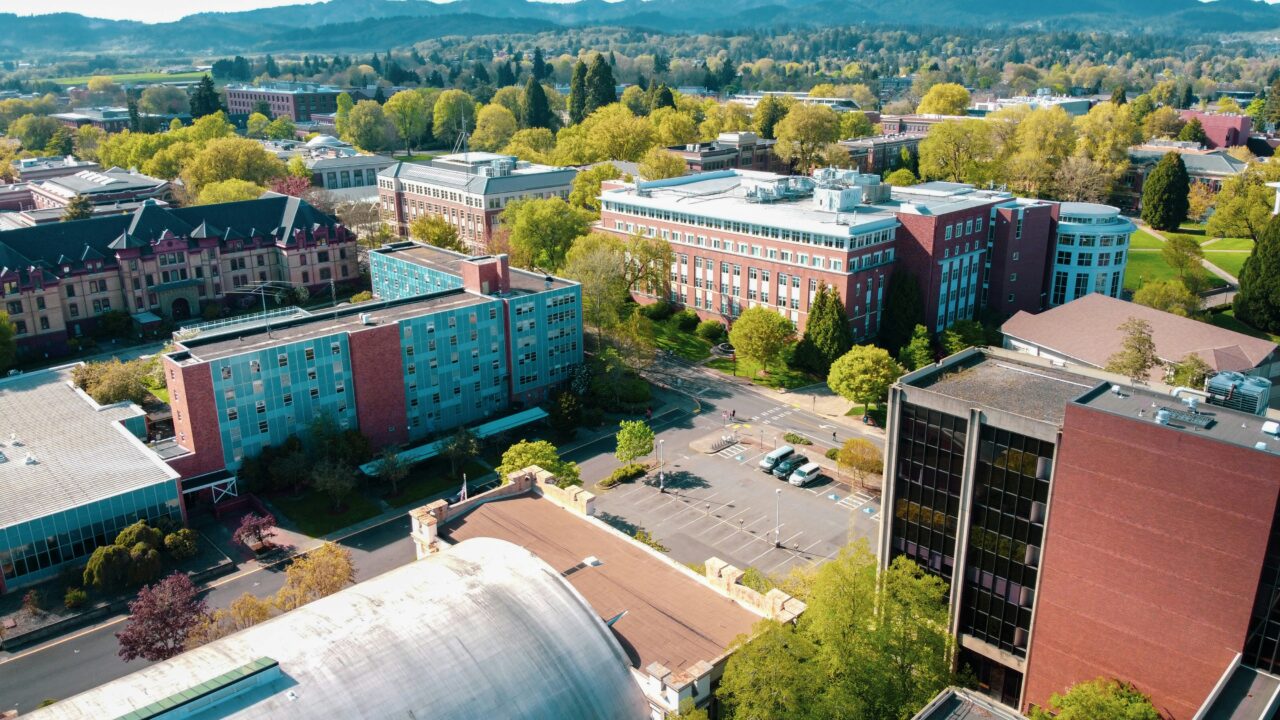
Less than 50 miles separate Autzen Stadium in Eugene from Reser Stadium in Corvallis. In college football terms, that is nothing — a drive that takes under an hour and crosses enough cultural terrain to feel like a border crossing between two distinct nations. One is a university built around liberal arts, global brand partnerships, and a uniform rotation that requires a spreadsheet to track. The other is a land-grant agricultural college that produced three College World Series titles in baseball and treats developmental football the way other programs treat five-star recruiting classes. For 130 years, they have been settling the argument on the field.
Oregon leads the all-time series 70–49–10. That number is accurate, and it tells only part of the story.
How It Started and What It Was Called
The first game was played on November 3, 1894, in Corvallis. Oregon lost 16–0. The series has been contested 129 times since, making it the fifth-most played rivalry in FBS history and the most played rivalry in the Western United States. It ran annually without interruption from 1945 through 2025 — a streak of 81 consecutive years ended not by rivalry fatigue but by conference realignment.
For most of its existence the game was called the Civil War. The first printed reference to that name appeared in 1929 in the Oregon Journal; it came into common use by 1937; before that it was known as the Oregon Classic or the State Championship Game. In 2020, both universities mutually agreed to retire the Civil War moniker amid the wave of name changes sparked by the George Floyd protests, connecting the game instead with the broader Rivalry Series branding. The records and history were preserved intact. The competitive fires were entirely unaffected. Fans of both teams still use the old name freely and without apparent guilt.
The Numbers and the Eras
Oregon’s 70–49–10 overall lead obscures three distinct chapters of domination.
Oregon State controlled long stretches of the early series, most definitively under Dee Andros from 1964 to 1971, going 8–2 in that stretch with physical, run-heavy football. The Beavers built an eight-game winning streak that remains tied for the longest by either program in series history. Running back Ken Simonton became the program’s all-time leading rusher and held the Pac-12 career rushing touchdown record at 59 for 16 years until Royce Freeman broke it in 2017.
Oregon seized control from the late 1990s onward. Phil Knight’s financial backing transformed the program’s infrastructure and recruiting reach, and coaches Mike Bellotti and then Chip Kelly built offenses that regularly dismantled Oregon State before bowl season. Oregon’s longest winning streak also stands at eight games — from 2008 to 2015 — tied with OSU’s 1964–1971 run. The Ducks had an undefeated run of 13 games from 1975 to 1987, but that includes the 1983 scoreless tie rather than 13 outright wins. Marcus Mariota, LaMichael James, and Royce Freeman each tormented OSU defenses regularly; Freeman broke Simonton’s record in the 2017 game, a 69–10 Oregon victory that remains the largest margin of victory in series history.
Oregon has won three straight: 31–7 in 2023 to clinch a Pac-12 Championship Game berth, 49–14 at Corvallis in September 2024, and 41–7 at Autzen in September 2025 — the 129th all-time meeting, with No. 6 Oregon’s Dante Moore throwing for 305 yards and four touchdowns. Oregon State tied it 7–7 in the first quarter and was outgained 585–147 the rest of the way.
The Games That Define It
1983 — The Toilet Bowl: The last Division I football game to end in a 0–0 tie, and the tenth and final tie in the series. Played in a Eugene downpour, the game produced 11 fumbles (six for turnovers), five interceptions, and four missed field goals. The NCAA instituted overtime rules in 1996 specifically to prevent a repeat. It has never come close to being replicated anywhere in the sport.
1994 — The Danny O’Neil Drive: Oregon trailed 13–10 in the fourth quarter at hostile Parker Stadium, needing a win to secure a Rose Bowl bid. Quarterback Danny O’Neil drove the Ducks 70 yards and hit Dino Philyaw with a 19-yard touchdown pass for a 17–13 win — Oregon’s first Rose Bowl appearance in 37 years.
1998 — Double Overtime at Reser: The first overtime game in series history. Oregon State, heavy underdogs, won 44–41 in double overtime. Beaver fans stormed the field after the first overtime when the Ducks failed on fourth down, requiring 15 minutes to clear — after which the Ducks scored to force a second overtime. Running back Ken Simonton scored the winner. It was Oregon State’s best record since 1971 and announced Mike Riley’s revival of the program.
2000 — Both Teams in the Top 10: For the first time in series history, both teams entered ranked in the top 10. No. 4 Oregon State beat No. 5 Oregon 23–13 in Corvallis, giving the Beavers their first-ever 10-win season. They were then shut out of the Rose Bowl when Washington beat Washington State the same day, but received a BCS at-large bid to the Fiesta Bowl, where they defeated Notre Dame 41–9.
2009 — The War for the Roses: For the first time in series history, a win guaranteed an outright Pac-10 title and Rose Bowl berth. Oregon won 37–33 in a back-and-forth game at Autzen. The Ducks represented the Pac-10 in the 2010 Rose Bowl, their first appearance since 1995.
2010 — College GameDay Comes to Corvallis: No. 1 Oregon entered the BCS standings’ second spot, needing a win to reach the national championship game. ESPN’s College GameDay broadcast from Corvallis for the first time. Oregon State, 5–6 and needing a win for bowl eligibility, lost 37–20. Oregon went to Glendale to face Auburn for the national title.
2020 — Jermar Jefferson in the Fog: In a COVID-shortened season with no fans in the stands, Oregon State running back Jermar Jefferson rushed for 226 yards — the most rushing yards by any player in series history — as the Beavers won 41–38, knocking No. 15 Oregon out of playoff contention on a foggy night in an empty Corvallis stadium. OSU’s first win over a ranked opponent since 2014.
2022 — The Comeback at Reser: No. 9 Oregon led No. 21 Oregon State 31–10 in the third quarter. The Beavers scored touchdowns on each of their next four drives to lead 38–34. Oregon drove to the OSU 3-yard line on the final possession, failed on fourth-and-goal, and Oregon State ran out the clock. Linebacker DJ Johnson of Oregon was caught on video punching an Oregon State fan after the game. No action was taken on the altercation.
The Platypus Trophy
In 1959, Oregon art student Warren Spady was commissioned to create a trophy for the game. He carved a wooden platypus — an animal with a duck’s bill and webbed feet alongside a beaver’s flat, paddle-like tail — as a perfect symbol for a rivalry between exactly those two programs. The trophy was awarded from 1959 to 1961, then lost for over 40 years, and rediscovered in 2005 in a closet inside Oregon’s MacArthur Court. Since 2007 it has been formally presented to the winning school’s alumni association — a more civilized arrangement than the previous system of organized theft and competitive arson that characterized student relations between the two campuses across the first half of the 20th century.
Two Universities, Two Identities
The cultural gap between these programs runs deeper than football. Eugene is Track Town USA. Bill Bowerman coached at Hayward Field from 1949 to 1972, trained 31 Olympic athletes and 51 All-Americans, and co-founded Nike with Phil Knight in 1964. The renovated Hayward Field — rebuilt with a $200 million Knight donation and opened in 2020 — is now the premier track and field venue in the world, having hosted the 2022 World Athletics Championships. Oregon’s Olympic sports legacy runs from Steve Prefontaine through a continuous pipeline of professional-caliber track and field athletes who choose Eugene specifically because of what training there means for their post-collegiate careers. That identity shapes how the university presents itself to recruits across every sport, not just football — and it is a genuine competitive advantage in NIL conversations, where personal brand matters as much as the program’s name.
Oregon State’s identity is built on different ground. The land-grant mission — agriculture, forestry, engineering, environmental sciences — is not a historical footnote; it is a genuine institutional priority. The Beavers won three College World Series titles in baseball (2006, 2007, 2018), built one of the most successful wrestling programs on the West Coast, and constructed an athletic culture that prizes cohesion and development over flash. When Oregon State tells a recruit this is a place where they will be developed rather than simply plugged in, the coaching records in this rivalry support that argument: Dee Andros went 9–2 in the series, Tommy Prothro went 5–3–2, and Trent Bray went 0–2 in his two seasons before being replaced by JaMarcus Shephard.
The Stadiums
Autzen Stadium (Eugene) holds 54,000, but its sunken bowl design and overhanging roof trap crowd noise and direct it downward onto the field with a force disproportionate to its capacity. It is routinely listed among the loudest venues in college football. Oregon’s longest active nonconference home winning streak — 37 games entering 2026 — has been built there. Before home games, a motorcycle revs and the crowd ignites. The streak of home teams winning this rivalry held from 1997 through 2006 before Oregon State snapped it with a double-overtime win at Autzen in 2007.
Reser Stadium (Corvallis) underwent the “Completing Reser” renovation and now holds approximately 35,500 fans in a configuration that brings the crowd close to the field. The chainsaw revving on third downs and the student section’s proximity to the action create an environment that visiting teams describe as physically uncomfortable in the best possible way. The Beavers went 17–2 at Reser across a recent 19-game home stretch.
The Recruiting War, NIL, and the Conference Divide
Oregon recruits nationally and globally. The Knight financial relationship funds infrastructure that competes with any program in the country — the Moshofsky Center training complex, uniform rotations that function as marketing campaigns, and NIL infrastructure built for visibility. Oregon’s NIL deals have turned game-day stars into endorsement earners, with the Pacific Northwest market and the Nike connection creating brand opportunities that recruits understand before they ever set foot on campus. Both programs operate under Oregon’s NIL laws, which give college athletes broad rights to monetize their name, image, and likeness through endorsements, social media partnerships, and appearances — with mandatory disclosure to the athletic department but no cap on earning potential. Oregon fans can back Ducks athletes directly through RallyFuel’s verified NIL deal platform, supporting the players they want to keep in Eugene and tracking real performance stats.
Oregon State has taken a fundamentally different path. The Beavers recruit heavily in the Pacific Northwest, Northern California, and the Polynesian islands, targeting undervalued players with raw potential. Both programs operate under the same Oregon NIL legal framework — the difference is the scale of the market and the infrastructure behind it. Dam Nation, the program’s original collective, was sold to Blueprint Sports in 2025, signaling a professionalization of the operation. Oregon State fans can back Beaver athletes through RallyFuel as part of that growing ecosystem.
The Big Ten distributes approximately $63 million per school annually — significantly more than any other conference — which has given Oregon resources that Oregon State, still navigating its post-Pac-12 scheduling landscape, cannot currently match in raw dollars. RallyFuel’s weekly college football predictions game lets fans from both programs earn points and direct them toward NIL support, and the schools leaderboard tracks total fan-driven contributions by program — a live measure of which fanbase is more invested in their athletes’ futures.
What the Gap Means
The most significant change to this rivalry is not the name, not the conference split, and not the shift from November to September. It is the gap. For the first time since 1944, the two programs will not play each other in 2026. Oregon State’s scheduling commitments made 2027 impossible to add as well. The series restarts in 2028, with Oregon hosting in odd years and Oregon State in even years, through at least 2033 — six more guaranteed games confirmed in September 2025.
Fans who grew up with this game as an annual certainty — on Thanksgiving weekend, cold and often wet, with bowl implications usually attached — will spend two Septembers without it. The agreement is real and contractually confirmed. But anyone who has watched conference realignment scatter rivalries across the country knows that two years without the game is a long time to test whether the appetite comes back as strong as it left.
It will. It always does. Fifty miles is not a distance that forgives easily, and 130 years of accumulated history doesn’t vanish because two schools found themselves in different conferences. When the ball is kicked off again at Autzen Stadium in 2028, the Platypus Trophy will be there, and so will every grievance that has been building since September 20, 2025.
Oregon leads the series 70–49–10. That number will be contested again soon enough.