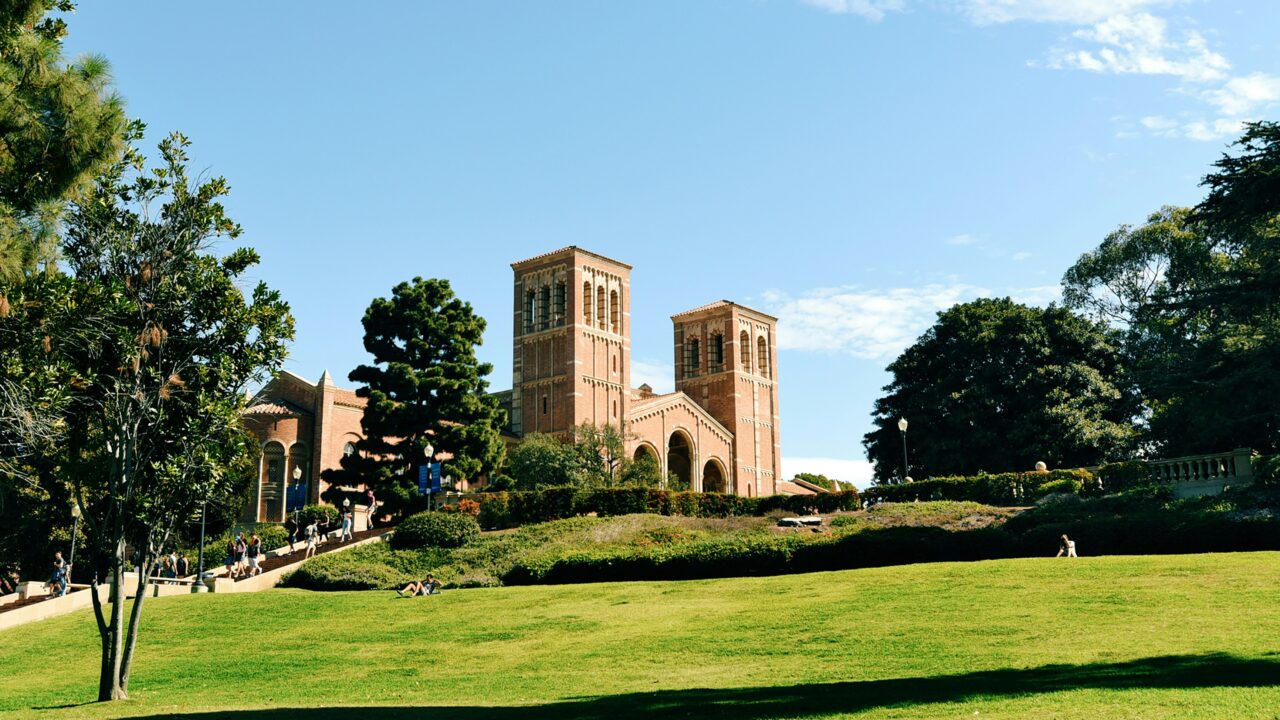
The campuses are 12 miles apart. Both sit inside the Los Angeles city limits. Until 1982, they shared the same stadium. They have been in the same athletic conference since 1928, and they moved to the Big Ten together in 2024. There is no rivalry in college sports quite like this one — not because of geography, but because of what geography produces when two elite programs are separated by a freeway and a century of institutional pride.
USC leads the football series 52–34–7. The Trojans have won 19 of the last 26 meetings. None of it quiets the argument, because the argument is not really about football.
How the Series Began — and What Happened to the Bell
The first football game between UCLA and USC was played on September 28, 1929, at the Los Angeles Memorial Coliseum. USC won 76–0, the largest margin of victory in series history. On the day of that first game, Los Angeles Times sportswriter Braven Dyer predicted: “In years to come, this game will probably be one of the football spectacles of the West.” He was not wrong. The series had barely begun and it already had its defining axis: USC as the established private powerhouse founded in 1880, UCLA as the upstart public institution that had only joined the Pacific Coast Conference a year earlier in 1928, with everything to prove.
In 1939, the UCLA alumni association gave the student body a gift: a 295-pound brass bell that had originally rung atop a Southern Pacific railroad locomotive. UCLA cheerleaders rang it after every Bruin point. It was called the Victory Bell. It lasted two years.
In 1941, six members of USC’s Trojan Knights spirit organization infiltrated the UCLA rooting section, loaded the bell onto a truck, took the key, and escaped. The bell was hidden for over a year — first in the Sigma Phi Epsilon basement, then in the Hollywood Hills, then in Santa Ana, and at one point beneath a haystack. A photograph of it appeared in a USC student publication. The prank war escalated so severely that the USC president threatened to cancel the rivalry entirely. On November 12, 1942, the student body presidents of both schools signed an agreement in front of Tommy Trojan: the Victory Bell would henceforth be the trophy for the annual game. The winner keeps it for a year and paints it their color — True Blue for UCLA, Cardinal for USC. USC currently has the Victory Bell after winning 29–10 on November 29, 2025.
The Football Series
The record tells a story of USC dominance with sustained UCLA resistance. The Trojans went 76–0 in the first meeting, then UCLA developed into a genuine program under Hall of Fame coach Henry “Red” Sanders in the 1950s. Sanders won UCLA’s only football national championship in 1954 and went 6–3 against USC. He was quoted as saying: “Beating ‘SC is not a matter of life or death, it’s more important than that.”
Under Terry Donahue from 1976 to 1995, UCLA went 10–9–1 in the series — the only stretch of near-parity in its history — and won eight consecutive years from 1991 to 1998, the longest winning streak by either program in series history.
Pete Carroll’s USC dynasty from 2002 to 2005 produced some of the most lopsided games in recent memory, including a 66–19 win in 2005 (later vacated). Then in 2006 — with USC ranked No. 2, needing only a win to face No. 1 Ohio State in the BCS Championship Game — UCLA won 13–9, ending USC’s 63-game streak of scoring 20-plus points per game and eliminating the Trojans from the national title race entirely.
Recent results: USC won 48–45 in 2022; UCLA won 38–20 in 2023; USC won 19–13 at the Rose Bowl in 2024; USC won 29–10 at the Coliseum in 2025, extending USC’s current winning streak to two.
The Game of the Century: 1967
On November 18, 1967, No. 1 UCLA met No. 2 USC at the Coliseum with the Rose Bowl, the national championship, and the Heisman Trophy simultaneously at stake. UCLA’s Gary Beban versus USC’s O.J. Simpson. The game went back and forth before USC won 21–20, with Simpson scoring all three touchdowns — including a 64-yard run — and blocking a critical kick. USC went to the Rose Bowl and won the national championship. Despite Simpson’s performance, Beban won the Heisman Trophy. Simpson won it the following year. It remains the only time in series history that a single game had the Rose Bowl berth, national title, and Heisman all on the line simultaneously, and it is widely cited as one of the greatest games of the 20th century.
The Traditions
The Home Jersey Rule: For most of the rivalry’s history, through 1981, both teams played their home games at the Coliseum. Because there was no road team, both wore their home jerseys — a Cardinal vs. Blue matchup that became tradition. A 1983 NCAA rule change mandated that away teams wear white, and the tradition stopped. In 2008, new UCLA coach Rick Neuheisel approached Pete Carroll about reviving it. Carroll agreed to forfeit a timeout to allow USC to wear cardinal — taking the penalty as a sporting gesture. The NCAA changed its rules for 2009 to officially permit color-on-color games when both teams agree and colors contrast. Every Battle of LA since has featured both teams in home jerseys.
Tommy Trojan and the Bruin Bear: During rivalry week, USC’s Trojan Knights wrap Tommy Trojan in duct tape and bubble wrap and hold a week-long vigil with the sign “Don’t Bruin your life.” UCLA’s Bruin Bear Security Force camps out in Bruin Plaza to protect the Bruin Bear, which has been encased in a $5,000 wooden puzzle box. The statue painting competition between the two student bodies has been going on for decades.
Troy Week vs. Beat ‘SC Week: USC holds its CONQUEST! bonfire rally during Troy Week, featuring the Trojan Marching Band, Song Girls, and Spirit Leaders. UCLA declares its week “Beat ‘SC Week” — officially “Blue and Gold Week.” Both schools host parades, rallies, and live entertainment for their respective spirit communities.
The Blood Bowl: The ROTC units from both schools — Naval and Army Officers Training Corps — compete in an annual flag football game on the Friday before the varsity game. The name reflects the often rough play. UCLA leads the Army series all time 15–11.
The Crosstown Cup: A year-round all-sports competition between the two programs across 19 NCAA-sanctioned sports. USC has won 14 of 22 competitions since 2001–02.
Beyond Football: The Scope of the Rivalry
UCLA and USC are second and third respectively on the list of NCAA schools with the most team championships in history — only Stanford has more. UCLA has 124 NCAA team championships; USC has 113. Their combined total would dwarf any other rivalry in American sports.
The scope runs through every sport simultaneously. In men’s basketball, UCLA leads the all-time series 153–114 and has won 11 NCAA championships behind John Wooden’s dynasty — Wooden won 10 titles in 12 years from 1964 to 1975, including seven consecutive, the most dominant run in the history of any major college sport. In men’s volleyball, UCLA has won 20 NCAA championships, the most of any school in that sport; USC has won 4. In men’s tennis, USC has won 21 NCAA championships — the most of any school in that sport — while UCLA has won 16. In water polo, UCLA leads the men’s NCAA championship count 13–10 and the all-time series 102–94–1. In football, USC has 33 Rose Bowl appearances to UCLA’s 12, and 8 Heisman Trophy winners (most in college football history) to UCLA’s 1.
The Olympic dimension is extraordinary. Through the 2020 Summer Olympics, USC athletes have won 326 medals and UCLA athletes 270. Their combined 596 medals would rank sixth on the all-time country list — above France, Australia, and Hungary. A USC Trojan has been a gold medalist at every Summer Olympics since 1912. UCLA and USC athletes combined account for more than one-fifth of all medals ever won by the United States.
The Academic Rivalry
USC was founded in 1880, when Los Angeles had a population of 11,000. UCLA was established in 1919 and moved to its Westwood campus in 1929, the same year the football rivalry began. The public-versus-private dynamic that shapes the institutions — UCLA’s in-state tuition around $13,000 versus USC’s roughly $60,000 — fuels a perpetual debate about access, prestige, and identity that runs through every neighborhood in Southern California.
Both were ranked in the US News Top 30 in 2022: UCLA at No. 20, USC at No. 27. Their graduate schools compete across film, law, medicine, business, and engineering. High schools across Southern California send graduates to both schools every year, and families divided between Trojan Cardinal and Bruin Blue are not a novelty — they are the norm.
The geography reinforces the divide. UCLA sits in Westwood, nestled between Brentwood, Bel-Air, and Beverly Hills. USC sits in University Park in South Los Angeles near Exposition Park — a different part of the city with a different character, different history, and different relationship to the communities around it. Both campuses are in Los Angeles, but they are not in the same Los Angeles.
The Big Ten Move and What It Changes
In 2024, both UCLA and USC left the Pac-12 and joined the Big Ten together — the oldest conference in the nation, founded in 1896, with a revenue-sharing cap of $20.5 million per school for 2025–26. The move was driven by television revenue and national visibility, and it was made simultaneously by both rivals, which is itself a testament to the rivalry’s nature: even when making the most significant institutional decision in modern conference history, UCLA and USC did it in tandem.
The Crosstown rivalry remains a protected matchup under the Big Ten‘s “Flex Protect Model,” guaranteeing the game continues annually regardless of scheduling changes. The Rose Bowl, historically the destination for the Pac-12’s conference champion, remains UCLA’s home stadium and the site of every even-year Battle of LA — now a Big Ten venue hosting a Big Ten game rather than a Pac-12 one.
NIL and How Fans Are Now Part of It
Both programs operate within California’s NIL ecosystem — California was the first state to pass NIL legislation with the Fair Pay to Play Act in 2019, establishing athlete-friendly standards that give both UCLA and USC athletes broad rights to monetize endorsements, social media, and appearances. The Los Angeles market is the largest media market in the country, giving athletes from both schools access to entertainment industry partnerships, brand deals, and visibility that programs in smaller markets cannot replicate.
UCLA fans can back Bruins athletes directly through RallyFuel’s verified NIL deal platform — supporting athletes across the 124-NCAA-championship program and tracking real performance stats. UCLA’s NIL infrastructure benefits from the Rose Bowl and Pauley Pavilion as commercial platforms, and the program’s alumni network in the entertainment and technology industries gives Bruin athletes distinctive brand-building opportunities.
USC fans can back Trojans athletes directly through RallyFuel. USC’s House of Victory collective and the Los Angeles corporate ecosystem give Trojan athletes the same commercial depth, anchored by the program’s unmatched Heisman history, 33 Rose Bowl appearances, and USC’s position since 1912 as the only university in the world to have a gold-medal-winning athlete at every Summer Olympics.
RallyFuel’s weekly college football predictions game lets fans earn points and direct them toward NIL support, the schools leaderboard tracks total fan-driven contributions — a live measure of which fanbase is more mobilized — and the Trophy Case tracks Heisman contenders throughout the season. USC has 8 Heisman winners, UCLA has 1. The rivalry has directly influenced the Heisman race: in 1967, Beban won it over Simpson despite USC winning the game; in 2022, Caleb Williams held his Heisman pose late in a USC win over UCLA at the Coliseum.
Why It Endures
USC leads the football series 52–34–7. UCLA leads men’s basketball 153–114. UCLA has more NCAA championships in volleyball. USC has more in tennis and baseball. In Olympic medals they are nearly inseparable. Neither program can define its identity without the other.
The two schools have shared a conference since 1928. They shared a stadium from 1929 to 1981. They moved to a new conference together in 2024. And every November — or late November — they meet at either the Coliseum or the Rose Bowl, both teams in home jerseys, the Victory Bell on the sideline, 12 miles and a century of accumulated rivalry between them.
There is no distance to speak of. That is the entire point.